


Payroll Taxes: What Business Owners Actually Need to Know (Without the Confusion)
Payroll taxes aren’t optional—and getting them wrong gets expensive
Most business owners don’t struggle with making money. They struggle with staying compliant while doing it.
Payroll taxes are one of the easiest places to make costly mistakes. Not because they’re complex (they are), but because they’re constant, regulated, and unforgiving.
If you’re running payroll—even for one employee—you’re responsible for getting this right.
This breakdown cuts through the noise and focuses on what actually matters: what you’re responsible for, where things go wrong, and how to stay ahead of it.
What payroll taxes actually are (and why they matter)
At a basic level, payroll taxes are amounts you:
- Withhold from employees
- Match as an employer
- Remit to federal and state agencies
These taxes fund programs like Social Security and Medicare—and the IRS treats them differently than most taxes.
Here’s the part most people miss:
Payroll taxes are considered “trust fund taxes.” You’re holding that money on behalf of the government. If it doesn’t get paid, it’s not just a business issue—it can become personal liability.
Your core responsibilities as an employer

This is where things tend to break down. Not because business owners don’t care—but because systems aren’t set up correctly.
1. Accurate calculation and withholding
You’re responsible for:
- Correct tax rates
- Proper employee setup (W-4, state forms)
- Ongoing updates when laws change
Mistakes here compound fast.
2. Timely deposits and filings
Payroll taxes don’t run on your schedule—they run on the IRS schedule.
Depending on your size, you’ll be on:
- Monthly deposit schedules
- Semi-weekly deposit schedules
- Quarterly and annual filings
Miss a deadline and penalties start stacking immediately.
3. Proper employee classification
This is a big one.
Misclassifying:
- Employees vs. contractors
- Owners vs. employees
…can completely change your tax obligations.
And yes, this is one of the most common audit triggers.
4. Clean, audit-ready records
You need to maintain:
- Payroll reports
- Tax filings
- Payment confirmations
- Employee documentation
If you ever get audited, this isn’t optional—it’s your defense.
The taxes you’re actually paying
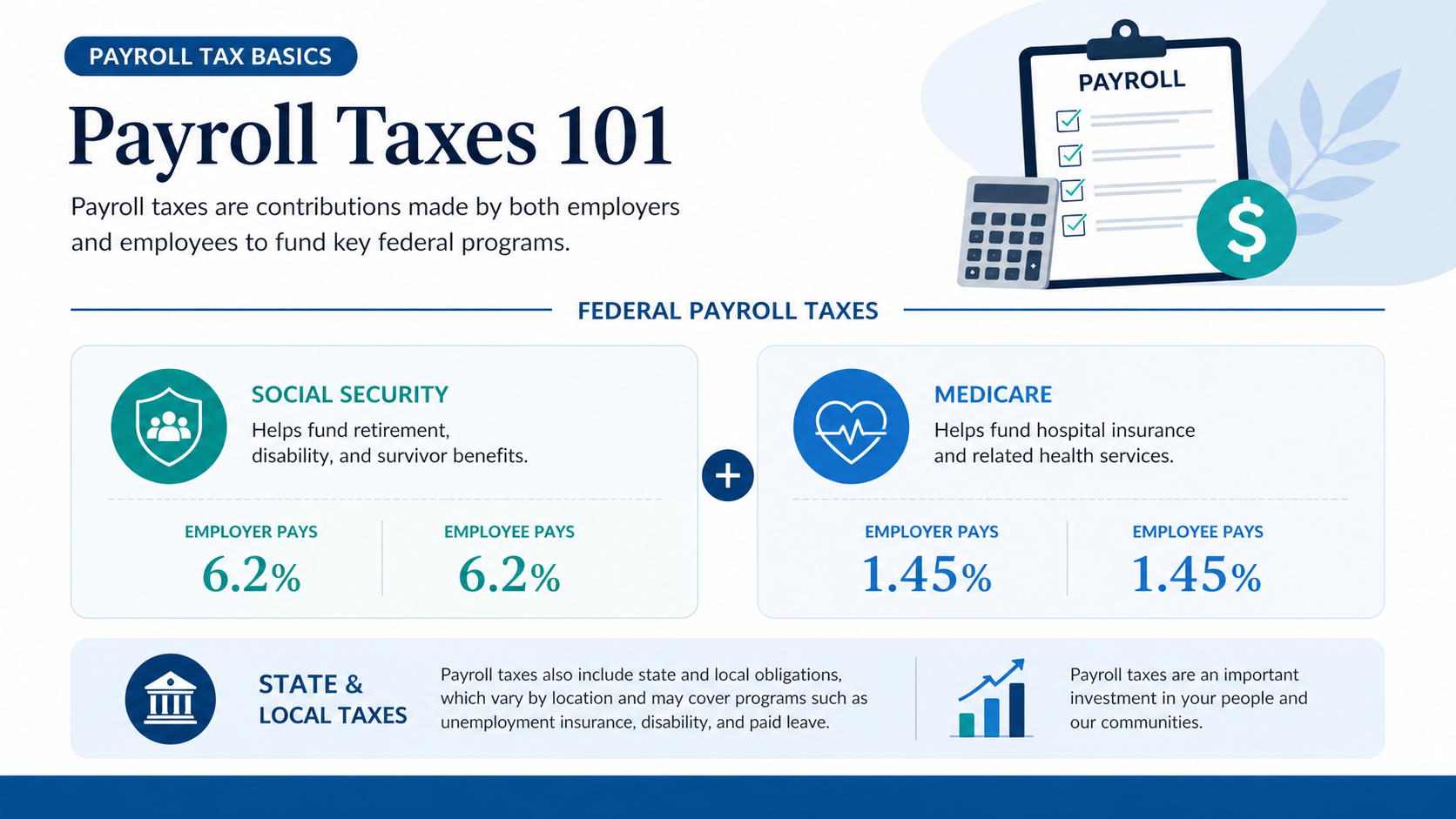
Let’s simplify it.
FICA Taxes (Federal)
- Social Security: 6.2% (you match 6.2%)
- Medicare: 1.45% (you match 1.45%)
That means: You’re paying 7.65% on top of every employee’s wages
And that’s before unemployment taxes and state obligations.
State and local payroll taxes
These vary—but ignoring them is where a lot of businesses get blindsided.
Different states = different rulesDifferent agencies = different deadlines
If you’re operating in multiple states, complexity increases fast.
Where business owners get into trouble
Let’s be direct—these are the most common failure points we see:
- Missing deposit deadlines
- Assuming payroll software “handles everything”
- Misclassifying workers
- Not reconciling payroll reports
- Letting errors stack over multiple quarters
And the big one:
Trusting the system without verifying the output
Software helps—but it doesn’t replace oversight.
How to actually stay compliant (without overcomplicating it)

This doesn’t require perfection. It requires structure.
Use payroll software—but don’t rely on it blindly
Automation reduces errors, but:
- Setup matters
- Inputs matter
- Oversight still matters
Consider outsourcing (if payroll isn’t your strength)
Done right, this:
- Reduces internal workload
- Improves accuracy
- Keeps filings on track
But here’s the catch:
You’re still responsible—even if a provider makes a mistake
So choose carefully.
Run periodic reviews
At minimum, you should be:
- Reconciling payroll reports quarterly
- Reviewing tax filings
- Spot-checking employee setups
Small issues caught early = no penalties later.
Stay ahead of deadlines
Set:
- Calendar reminders
- Filing workflows
- Internal checkpoints
Because once you’re late, you’re already behind.
Filing deadlines: where timing matters most
Payroll taxes follow strict timelines:
- Deposits: Monthly or semi-weekly
- Forms: Quarterly (941), Annual (940, W-2s)
Miss these and you’re dealing with:
- Penalties
- Interest
- Potential notices or audits
This is one of the easiest things to get right—and one of the most expensive to ignore.
The real cost of getting payroll taxes wrong
This isn’t just about penalties.
It can lead to:
- IRS notices and audits
- Cash flow disruptions
- Personal liability (in extreme cases)
- Cleanup costs that far exceed doing it right upfront
We’ve seen businesses spend 5–10x more fixing payroll issues than they would have spent preventing them.
Final Takeaways: Gain Control of Your Payroll Tax Process
Payroll taxes aren’t just a compliance task—they’re an operational system.
If your payroll process is:
- Reactive
- Disorganized
- Or overly manual
…it’s not a matter of if issues show up—it’s when.
The goal isn’t complexity. It’s control.
Author Bio
Missy Dennis, CPAPartner | FJ & Associates, PLLC | Kaysville, Utah
Missy holds a Master of Accounting degree from the University of Utah and is a licensed Certified Public Accountant.
She is committed to providing clear, accurate, and actionable guidance so clients can navigate complex financial decisions with confidence.
With more than twenty years of public accounting experience, Missy Dennis specializes in:
- Tax preparation and tax advisory
- Bookkeeping strategy alignment
- Estate and trust taxation
- Audit and consulting services
- Low-income housing tax credits
- Non-profit accounting
- Small- and mid-sized business advisory
