

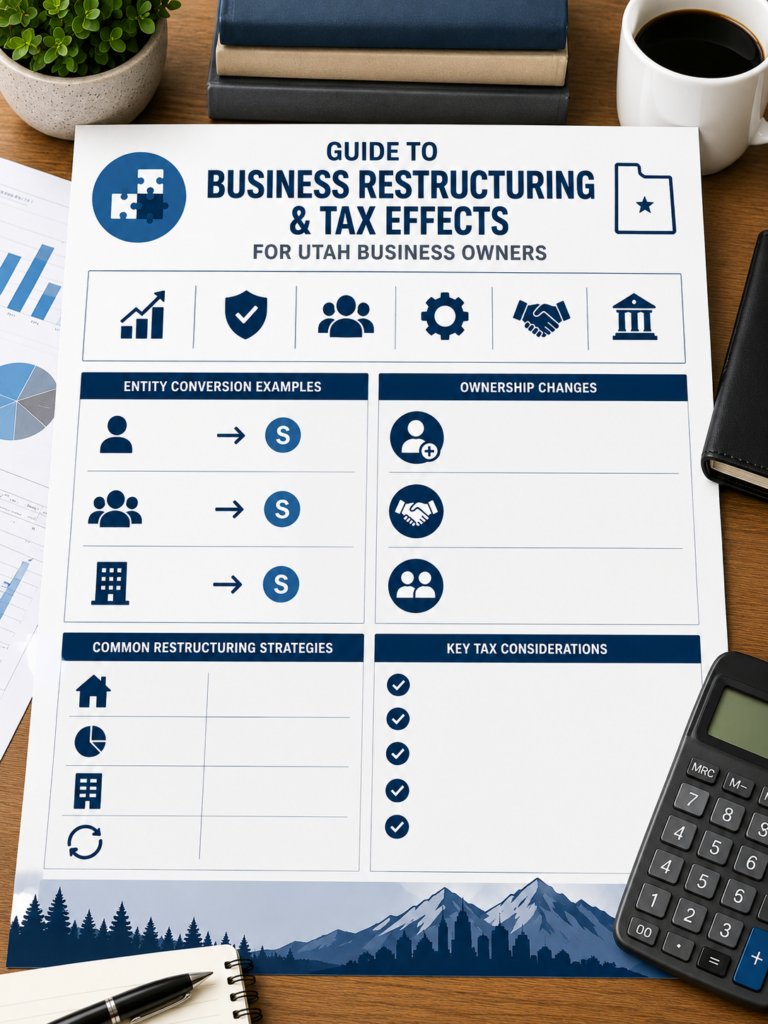
 Business restructuring — changing the legal structure, ownership composition, or operational organization of an existing business — is one of the most tax-sensitive areas in all of business planning. Done correctly, a restructuring can reduce ongoing tax liability, protect assets, facilitate ownership transitions, and position the business for growth or sale. Done without proper planning, it can trigger immediate taxable events, create unexpected liabilities, and permanently impair favorable tax attributes.
This guide covers the most common restructuring scenarios for Utah small and mid-sized businesses: entity conversions, ownership changes, spin-offs and divisions, and operational reorganizations.
Why Businesses Restructure
Businesses restructure for many reasons — few of them tax-driven initially:
- Growth: A sole proprietorship that has grown to $500,000 in annual profit needs the self-employment tax relief of an S-Corp structure
- Liability protection: A general partnership needs the protection of an LLC
- Ownership changes: Adding a partner, buying out a departing owner, or preparing for a succession event
- Operational separation: Separating operating assets from real estate holdings for liability and tax planning
- Acquisition preparation: Restructuring to achieve a cleaner deal structure before a sale
- Financing: Lenders or investors require a specific entity structure
Regardless of the business reason, every restructuring has a tax consequence that must be modeled before any filing or transfer occurs.
Entity Conversion: Changing Your Business Structure
Sole Proprietor or Single-Member LLC → S-Corporation
This is the most common restructuring for growing Utah businesses. When net self-employment income exceeds approximately $60,000–$80,000, the payroll tax savings from S-Corp reasonable salary treatment typically exceed the additional compliance costs.
How it works:
- If operating as a sole proprietor: form an LLC or corporation in Utah
- File IRS Form 2553 to elect S-Corp tax treatment (within 75 days of formation for the current year, or by March 15 for the following year)
- Establish reasonable compensation — pay yourself a W-2 salary; remaining profit is distributed without FICA
Tax effects:
- W-2 wages are subject to FICA (7.65% employee + 7.65% employer = 15.3%)
- S-Corp distributions above salary are not subject to FICA
- Example: $200,000 net profit, $80,000 reasonable salary → FICA on $80,000 only; saves approximately $18,400/year vs. full SE tax
Utah state effects:
- S-Corp files Utah TC-20S; income passes through to owners on K-1s
- Consider the Utah PTET election to deduct Utah income tax at the entity level — see our Utah PTET guide
Pitfalls:
- Unreasonably low salary attracts IRS scrutiny
- S-Corp election restrictions: no more than 100 shareholders, one class of stock, only eligible shareholders (no non-resident aliens, no C-Corps as shareholders)
- Built-in gains tax: if the entity previously operated as a C-Corp and converted to S-Corp, assets with unrealized gain at conversion are subject to entity-level tax if sold within 5 years
Partnership or Multi-Member LLC → S-Corporation
Converting a partnership to S-Corp tax treatment requires that all partners become shareholders (possible) and that all interests constitute one class of stock (more complex if economic interests differ among partners). The conversion may trigger gain recognition if liabilities exceed basis under Section 752.
This conversion requires careful modeling — sometimes retaining the partnership/multi-member LLC structure while electing S-Corp treatment is not possible without restructuring ownership.
C-Corporation → S-Corporation
A C-Corp can elect S-Corp status on Form 2553. The election does not trigger immediate recognition of built-in gains — but those gains remain subject to the built-in gains tax for 5 years. C-Corps with significant appreciated assets should model the BIG tax exposure before converting.
Additionally, any C-Corp earnings and profits (E&P) accumulated before the S election must be tracked separately; distributions from E&P are taxable dividends, not tax-free returns of basis.
Ownership Changes
Adding a New Owner
Adding a new partner or member to an existing LLC or S-Corp is a restructuring event with tax consequences:
- LLC/Partnership: Admitting a new member who contributes cash is generally tax-free to existing members. Admitting a new member who contributes property may trigger gain recognition under Section 704(c) if the property has unrealized appreciation. The partnership agreement must be amended to reflect the new ownership percentages and profit/loss allocations.
- S-Corporation: Issuing new shares to a new shareholder is generally tax-free if done at fair market value. Issuing shares below fair market value may create compensation income to the new shareholder. Care must be taken not to create a second class of stock, which would terminate the S election.
Buying Out a Departing Owner
- LLC/Partnership: A departing partner’s interest can be purchased by the remaining partners (sale of partnership interest, generally capital gain to the seller) or redeemed by the partnership itself (a liquidating distribution). The tax treatment differs, and Section 736(b) and 736(a) distinguish between payments for the partner’s share of partnership property vs. payments that are treated as distributive shares or guaranteed payments.
- S-Corporation: A departing shareholder sells stock — generally capital gain treatment. The S-Corp may elect to treat the disposition as an asset sale under Section 338(h)(10) if a third party is buying the shares.
Death or Disability of an Owner
At death, a deceased owner’s interest receives a stepped-up basis to fair market value under Section 1014. This step-up eliminates the deferred gain on appreciation that occurred during the owner’s lifetime — a powerful estate planning tool. Buy-sell agreements funded with life insurance ensure liquidity to buy out the deceased owner’s estate at a pre-agreed price.
Spin-Offs and Business Divisions
Separating Operating Assets from Real Estate
A common Utah restructuring: the operating business holds real property used in operations. Separating the real estate into a distinct entity (typically an LLC taxed as a disregarded entity or partnership) and charging the operating company rent accomplishes several goals:
- Isolates liability: a slip-and-fall at the operating business cannot reach the real estate
- Creates deductible rent expense for the operating entity
- Positions the real estate for separate sale, refinancing, or estate transfer
- Allows different ownership structures for each entity
Tax effects: Transferring property from an operating entity to a new related entity is a taxable event unless structured as a tax-free contribution under Section 721 (for partnerships) or Section 351 (for corporations). These non-recognition provisions require careful compliance — the transferor must not receive “boot” (cash or other non-qualifying consideration) that exceeds basis.
Creating a Holding Company Structure
A holding company owns the stock or interests of one or more operating subsidiaries. Benefits include:
- Centralized ownership and management
- Liability separation between subsidiaries
- Intercompany loan and dividend planning
- Cleaner exit for buyers who can acquire a single holding company
Formation of a holding company by contributing existing LLC or S-Corp interests is generally tax-free under Section 351 or 721, subject to requirements.
Tax-Free Reorganizations (Corporate)
 For C-Corporations, IRC Sections 368 et seq. define several types of “tax-free reorganizations” that allow mergers, acquisitions, and restructurings without immediate gain recognition — provided the transaction meets specific continuity of interest, business purpose, and other requirements. These include:
- Type A: Statutory mergers and consolidations
- Type B: Stock-for-stock acquisitions (acquiring corporation receives at least 80% of target’s stock in exchange for its own voting stock)
- Type C: Stock-for-assets acquisitions
- Type D: Divisive reorganizations (spin-offs, split-offs, split-ups) — the most complex type
Tax-free reorganization treatment is not available for pass-through entities (LLCs, partnerships, S-Corps) — those entities have different non-recognition rules under Sections 351, 721, and 1031.
Utah-Specific Restructuring Considerations
Utah LLC Conversions
Utah allows statutory conversions of entities under the Utah Revised Business Corporation Act and the Utah Revised Uniform Limited Liability Company Act. A sole proprietorship converting to LLC, or an LLC converting to a corporation, can be done through a statutory conversion filing at corporations.utah.gov without dissolving and reforming — preserving contracts, licenses, and accounts.
Utah Transfer Taxes
Utah does not impose a transfer tax on real property transfers between related entities (subject to documentation requirements). However, county recording fees apply to any deed recorded with the county recorder.
Utah Pass-Through Entity Tax After Restructuring
After any restructuring that changes the entity type or ownership composition, review the Utah PTET election status. The election must be remade for each tax year and may require updated documentation if ownership has changed.
Modeling the Tax Cost of a Restructuring
Before executing any restructuring, we model the following:
- Current tax basis of each asset and ownership interest
- Fair market value of the business or assets being transferred
- Built-in gain subject to recognition at the entity and owner level
- Character of recognized gain — ordinary income vs. capital gain
- Non-recognition provisions available and their requirements
- Post-restructuring tax efficiency — will the new structure reduce ongoing tax liability enough to justify the restructuring cost?
This analysis must be completed before any filing, transfer, or signing.
Call (801) 927-1337 or visit cpaone.net/tax-planning to schedule a restructuring consultation. We work with Utah business owners to model tax consequences, identify non-recognition strategies, and execute restructurings that achieve business goals without unnecessary tax cost. Questions can also be sent to admin@cpaone.net.
Author Bio | Missy Dennis, CPA | Partner | FJ & Associates, PLLC | Kaysville, Utah | Missy holds a Master of Accounting degree from the University of Utah and is a licensed Certified Public Accountant. She is committed to providing clear, accurate, and actionable guidance so clients can navigate complex financial decisions with confidence. With more than twenty years of public accounting experience, Missy Dennis specializes in: Tax preparation and tax advisory; Bookkeeping strategy alignment; Estate and trust taxation; Audit and consulting services; Low-income housing tax credits; Non-profit accounting; Small- and mid-sized business advisory.
