

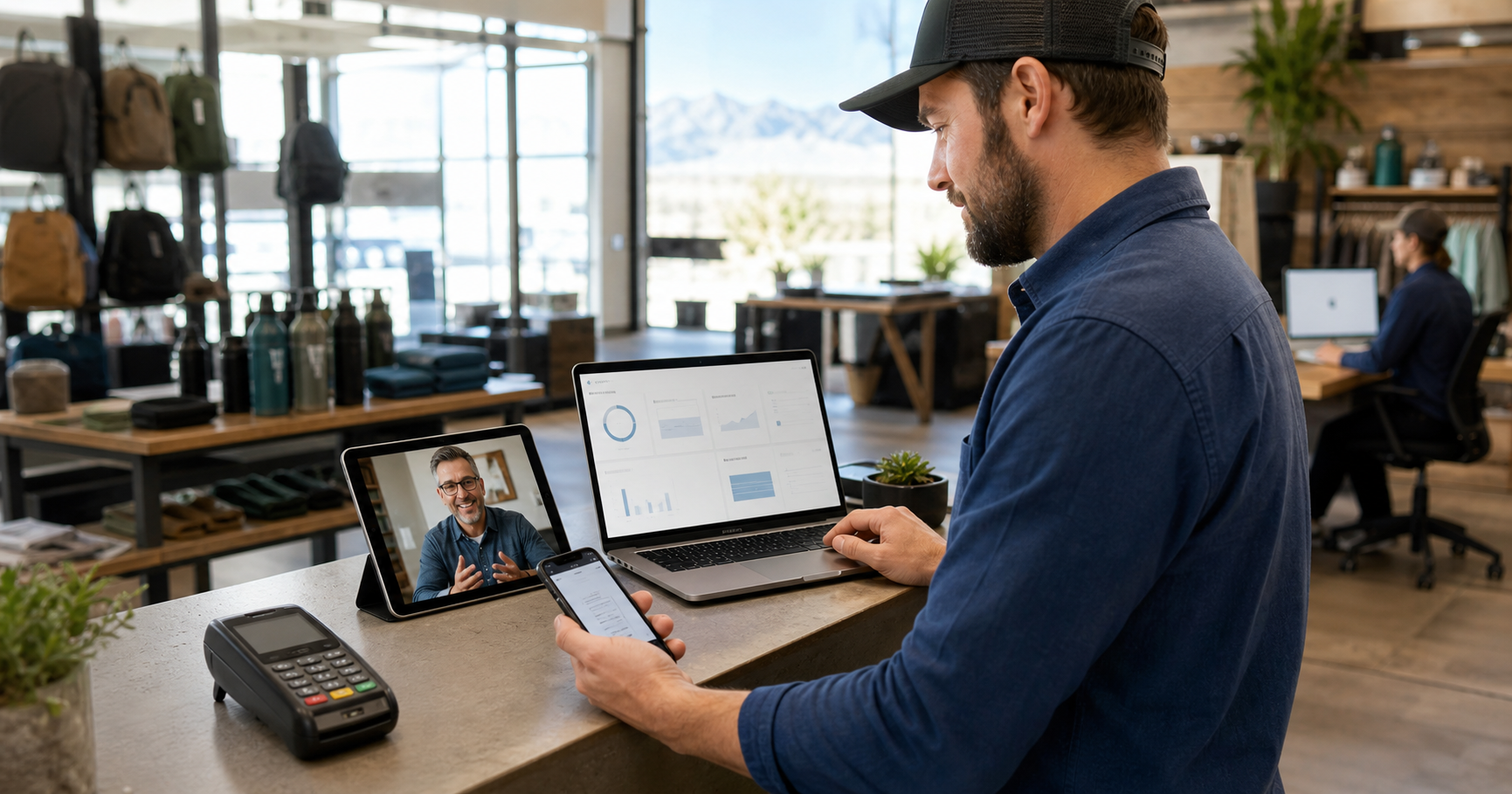
Desktop accounting software made sense in 2005. Today, it creates unnecessary constraints — your books live on one machine, your CPA can’t access your file without a data export, your data isn’t backed up automatically, and software updates are manual and often delayed. Cloud accounting solves all of these problems and introduces capabilities that desktop software can never replicate.
FJ & Associates, PLLC helps Utah small businesses migrate to cloud accounting platforms and configure them to deliver maximum value. This page explains what you actually gain — beyond the marketing language — when you move your books to the cloud.
Ready to move your accounting to the cloud? Call (801) 927-1337 or email admin@cpaone.net.
Real-Time Financial Visibility
The most impactful benefit of cloud accounting is that your financial data is always current. When your bank feed connects directly to your accounting software, transactions import automatically — usually within one business day. Your P&L and cash position reflect what’s actually happening in your business, not what happened when you last manually entered data.
For business owners, this means:
- Checking your cash balance takes seconds, not a call to your bookkeeper
- You can see whether a month is trending toward or away from budget before it’s over
- You can answer a lender’s question about your current revenue without waiting for a financial statement
For your CPA, it means we can review your books at any time — catching errors as they occur rather than discovering them at year-end when they’re expensive to unwind.
Anywhere Access for Multi-Location and Remote Teams
Cloud accounting software is browser-based. Your bookkeeper can work from home, your CPA in Kaysville can access your file from their office, and you can check a report from your phone on a job site — all simultaneously, without emailing files or maintaining a shared network drive.
This matters practically in several scenarios:
- Your part-time bookkeeper works remotely — no VPN or shared desktop required
- You have employees at multiple Utah locations — expense reports and approvals route through the system without paper
- Your CPA needs to post an adjusting entry — done directly, in real time, with no file transfer
See our virtual CPA services overview for how we leverage cloud access to serve clients across Utah without requiring in-office meetings.
Automatic Bank Reconciliation
Manual bank reconciliation — downloading a bank statement, comparing it line-by-line to your books, marking each transaction — takes hours and is prone to error. Cloud platforms connect directly to your bank and credit card accounts. Transactions import automatically, matching rules handle recurring items, and reconciliation becomes a quick review rather than a data entry project.
The practical result: monthly reconciliation takes minutes instead of hours. Discrepancies are caught immediately. And your bank balance in your accounting software matches your actual bank balance — something that is rarely true in manually maintained systems.
Seamless Collaboration with Your CPA
Cloud accounting fundamentally changes the CPA-client relationship. Instead of collecting documents at year-end and working backward through a year of transactions, we work in your live file throughout the year:
- We see transactions as they occur and can flag questions immediately
- We post adjusting entries directly — no sending files back and forth
- We access your reports on demand without a report-generation request
- Tax preparation is faster and more accurate because the books are already current
For clients on our monthly bookkeeping and CPA review services, cloud access eliminates the friction that makes traditional CPA relationships feel slow and reactive.
Automated Workflows That Reduce Manual Work
Cloud platforms integrate with hundreds of third-party applications — payment processors, payroll providers, expense management tools, CRM systems, time-tracking software. These integrations eliminate the manual data entry that makes bookkeeping time-consuming:
- Stripe payments post automatically as income
- Gusto or ADP payroll journals sync to your books without manual entry
- Hubdoc or Dext captures receipts from your phone and attaches them to transactions
- Shopify or WooCommerce sales sync directly without manual reconciliation
The result is a bookkeeping system that largely maintains itself — requiring human review and judgment rather than data entry. See our automated bookkeeping guide for specific tools and integrations we recommend.
Automatic Data Backup and Disaster Recovery
Desktop accounting data lives on a hard drive. If that hard drive fails — or if your office floods, burns, or is broken into — your financial records may be gone. Cloud accounting data is stored on enterprise-grade server infrastructure with automatic, redundant backups. You cannot lose your financial data through hardware failure, theft, or physical disaster.
For IRS audit purposes, this matters. The IRS requires businesses to retain financial records for a minimum of 3 years (and longer for certain items). Cloud accounting ensures those records exist and are accessible when needed.
See our cloud accounting security guide for how your financial data is protected in the cloud.
Scalability Without IT Complexity
Desktop software requires installation, maintenance, license management, and compatibility with your operating system. Cloud software requires a browser. As your business grows and adds users, locations, or complexity, your cloud accounting platform scales with you — no server upgrades, no multi-user license headaches, no IT department required.
Choosing the Right Cloud Platform
The benefits above apply to all major cloud accounting platforms, but the specific implementation varies. We work with QuickBooks Online, Xero, and other cloud platforms and can advise on the right choice for your business. See our cloud accounting software comparison, QuickBooks Online setup guide, and Xero setup guide for detailed platform guidance.
Move Your Books to Where Your Business Actually Lives
Cloud accounting isn’t a future technology — it’s the current standard for well-run small businesses. If you’re still on desktop software or spreadsheets, you’re working harder than you need to for less financial visibility than you deserve.
Call (801) 927-1337 | Email admin@cpaone.net | 612 N Kays Dr Suite 120, Kaysville, UT 84037
Related Services
- Cloud Accounting Security
- Integrating Cloud Apps with Your Accounting Software
- Automated Bookkeeping Tools
- QuickBooks Online Setup & Support
- Paperless Accounting
About the Author: Missy Dennis, CPA — Partner, FJ & Associates, PLLC | Kaysville, Utah
Missy holds a Master of Accounting degree from the University of Utah and is a licensed Certified Public Accountant. She is committed to providing clear, accurate, and actionable guidance so clients can navigate complex financial decisions with confidence. With more than twenty years of public accounting experience, Missy Dennis specializes in: tax preparation and tax advisory; bookkeeping strategy alignment; estate and trust taxation; audit and consulting services; low-income housing tax credits; non-profit accounting; and small- and mid-sized business advisory.
