

 The United States tax system operates on a pay-as-you-go basis. Employees have income tax withheld from every paycheck; self-employed individuals and business owners who do not have withholding must make estimated tax payments throughout the year. Failing to make adequate payments — or making them late — triggers an underpayment penalty from the IRS and a separate penalty from the Utah State Tax Commission.
Many business owners discover this requirement the hard way: a large tax bill in April accompanied by a penalty notice for underpayment during the prior year. This guide explains who must pay, how much to pay, when to pay, and how to calculate your Utah obligations alongside your federal ones.
Who Must Make Estimated Tax Payments?
The General Rule
You are required to make federal estimated tax payments if you expect to owe at least $1,000 in federal income tax after subtracting withholding and credits, AND your withholding and credits cover less than the lesser of:
- 90 percent of the tax shown on the current year’s return, or
- 100 percent of the tax shown on the prior year’s return (110 percent if your prior-year AGI exceeded $150,000)
If either safe harbor is met, no penalty applies even if you owe a large balance at filing.
Who Is Most Commonly Affected
Estimated payments are typically required for:
- Sole proprietors and single-member LLC owners
- Partners in partnerships
- S-Corp shareholders who receive distributions in excess of salary
- Freelancers and independent contractors
- Rental property owners with significant net income
- Business owners who receive a large year-end bonus not adequately covered by withholding
Federal Estimated Tax Payment Deadlines
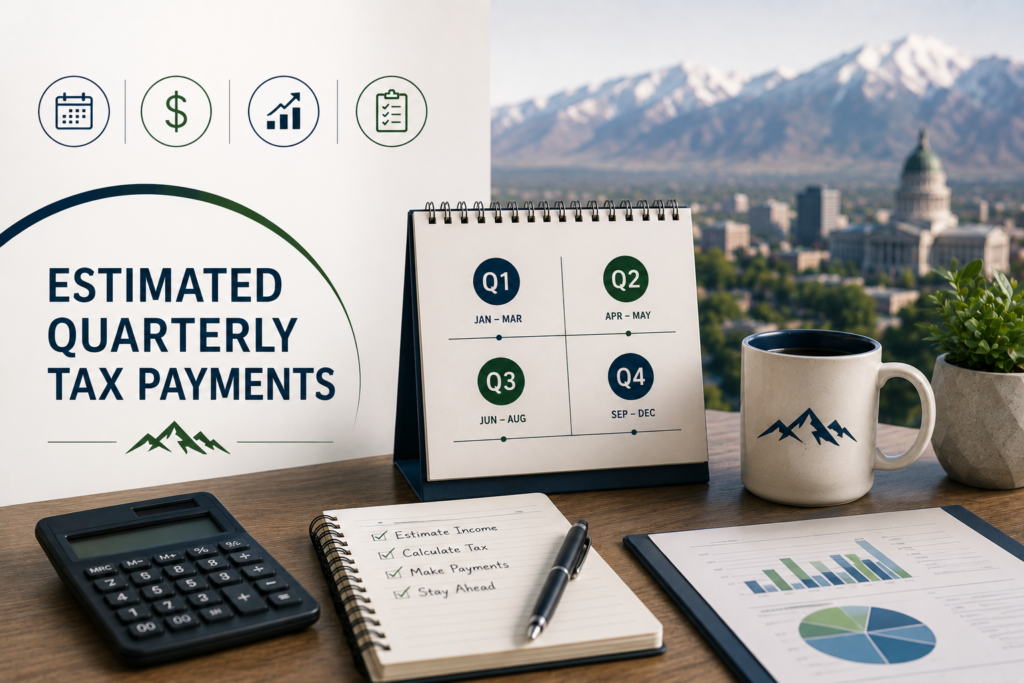
Federal estimated tax payments for calendar-year taxpayers are due on:
| Payment | Income Period Covered | Due Date |
|---|---|---|
| Q1 | January 1 – March 31 | April 15 |
| Q2 | April 1 – May 31 | June 16 |
| Q3 | June 1 – August 31 | September 15 |
| Q4 | September 1 – December 31 | January 15 (following year) |
Note: The Q2 deadline is June, not July — it covers only two months. This frequently causes underpayment for taxpayers who think of quarters as equal.
Payments can be made online through EFTPS (the IRS Electronic Federal Tax Payment System), the IRS Direct Pay portal, by check with a payment voucher (Form 1040-ES), or through certain tax software.
Utah Estimated Tax Payment Deadlines
Utah follows the federal schedule for individual income tax (including self-employed taxpayers):
- Q1: April 15
- Q2: June 16
- Q3: September 15
- Q4: January 15
Utah estimated payments are made through the Utah State Tax Commission’s Taxpayer Access Point (TAP) system at tap.utah.gov, or by check with a Utah TC-546 payment coupon.
Utah Corporate Estimated Tax
C-Corporations with annual Utah tax liability exceeding $3,000 must make quarterly estimated payments. Utah corporate estimated payments are due on the 15th day of the 4th, 6th, 9th, and 12th months of the tax year. Corporations pay via TAP or check with the Utah TC-559 coupon.
Calculating Your Estimated Tax Payment Amount
 Method 1: Prior-Year Safe Harbor (Simplest)
Divide last year’s total tax liability by four and pay that amount each quarter. If your prior-year AGI was $150,000 or less, this eliminates any underpayment penalty even if this year’s income is much higher. If your prior-year AGI exceeded $150,000, you must pay 110 percent of last year’s tax divided by four.
Example: Your 2023 federal tax liability was $20,000 and your AGI was $120,000. Your 2024 quarterly payment is $20,000 ÷ 4 = $5,000 per quarter.
Method 2: Annualized Income Method (Best for Variable Income)
If income is highly seasonal or variable — construction, retail, agriculture, tourism — the annualized income method calculates each quarterly payment based on actual income earned through that quarter, then annualizes to project the full-year liability. This method requires more calculation but eliminates the penalty for taxpayers who earn most of their income in the fourth quarter. It is calculated on IRS Form 2210, Schedule AI.
Method 3: Current-Year Projection
Estimate your full-year income, deductions, and credits for the current year, calculate the projected tax, and pay 25 percent per quarter. This method is most accurate if income is relatively predictable but requires updating the projection throughout the year.
Self-Employment Tax: The Hidden Component
Self-employed individuals — sole proprietors, partners, and LLC members — owe self-employment (SE) tax in addition to income tax. SE tax is 15.3 percent on net self-employment earnings up to the Social Security wage base ($168,600 in 2024) and 2.9 percent on earnings above that amount.
Half of SE tax is deductible as an adjustment to gross income on your federal return. When calculating estimated payments, include both income tax AND self-employment tax in your projected liability.
Example: A sole proprietor with $100,000 of net profit owes approximately:
- SE tax: $100,000 × 0.9235 × 15.3% = $14,130
- Federal income tax: approximately $14,000–$18,000 depending on filing status and deductions
- Utah income tax: approximately $4,650
- Total annual liability: approximately $33,000–$37,000
- Quarterly estimated payments: approximately $8,250–$9,250 per quarter
Quarterly Payment Workflow
Step 1: Set Up a Tax Reserve Account
Open a dedicated savings account and transfer 25–30 percent of every payment or revenue deposit into it. For a sole proprietor, every time $10,000 lands in your business account, transfer $2,500–$3,000 to the tax reserve account immediately.
Step 2: Make Payments Through the Correct Channels
Federal: EFTPS.gov (requires enrollment). IRS Direct Pay at IRS.gov accepts payments without enrollment.
Utah: TAP.Utah.gov accepts ACH payments and credit/debit cards. Mailed payments should include Form TC-546 and postmark before the due date.
Step 3: Record Every Payment
Record each estimated tax payment in your accounting software — QuickBooks, Xero, or Wave — as a draw or distribution (for sole proprietors) or as a tax payment account entry (for entities).
Step 4: Reconcile Quarterly with Your CPA
Each quarter, share your year-to-date income and expense reports with your CPA. A brief quarterly review call takes 20–30 minutes and allows your estimated payment to be adjusted for actual results rather than the prior-year estimate.
What Happens If You Miss or Underpay
Federal Underpayment Penalty
The IRS calculates the underpayment penalty at the federal short-term rate plus 3 percentage points, applied to the underpaid amount for each day it remains underpaid. In recent years this has ranged from 7 to 8 percent annually.
Utah Underpayment Penalty
Utah imposes a separate underpayment penalty at the Utah interest rate (which adjusts annually) on each underpaid quarter.
Penalty vs. Extension Confusion
Filing a tax extension does not extend the time to pay taxes. If you file an extension and pay the balance on October 15 (the extended due date), interest and potentially a failure-to-pay penalty have been accruing since April 15. Extensions extend filing, not payment.
Estimated Taxes for S-Corp Shareholders
An S-Corp shareholder who is also an employee has FICA taxes withheld from their W-2 salary. However, income tax withholding on the W-2 salary must be set high enough to cover both the shareholder’s income tax on their salary AND the pass-through income allocated from the S-Corp.
One strategy: ask your payroll processor to increase the income tax withholding on your W-2 to cover your projected pass-through income. Every dollar withheld from payroll is treated as paid equally throughout the year, regardless of when it was actually withheld — eliminating the need for separate estimated tax payments.
See our S-Corp tax guide for more on managing S-Corp shareholder tax obligations.
Estimated Tax Planning Calendar for Utah Small Business Owners
| Month | Action |
|---|---|
| January | Review prior-year tax liability; set Q1 payment amount |
| April 15 | Pay Q1 federal and Utah estimated taxes |
| June 16 | Pay Q2 federal and Utah estimated taxes |
| August | Review Q3 actual income; consider mid-year planning meeting with CPA |
| September 15 | Pay Q3 federal and Utah estimated taxes |
| October–November | Year-end planning meeting; set Q4 payment amount |
| January 15 | Pay Q4 federal and Utah estimated taxes |
Get Your Estimated Tax Calculations Right
Miscalculating estimated taxes is one of the most common and most correctable sources of April tax surprises. A 30-minute projection call with your CPA in January sets your baseline. Quarterly check-ins keep it current.
Call FJ & Associates at (801) 927-1337 or email admin@cpaone.net to schedule your estimated tax review. We serve self-employed individuals, sole proprietors, S-Corp owners, and partners throughout Utah’s Wasatch Front and statewide.
Author Bio | Missy Dennis, CPA | Partner | FJ & Associates, PLLC | Kaysville, Utah | Missy holds a Master of Accounting degree from the University of Utah and is a licensed Certified Public Accountant. She is committed to providing clear, accurate, and actionable guidance so clients can navigate complex financial decisions with confidence. With more than twenty years of public accounting experience, Missy Dennis specializes in: Tax preparation and tax advisory; Bookkeeping strategy alignment; Estate and trust taxation; Audit and consulting services; Low-income housing tax credits; Non-profit accounting; Small- and mid-sized business advisory.
