


One of the most frustrating questions a business owner can ask is:
“My profit and loss statement says I made money. So why is my bank account almost empty?”
It feels like the numbers should match.
If your business showed an $80,000 profit, it seems logical to assume there should be something close to $80,000 sitting in the bank.
But that is not how financial statements work.
Profit and cash are related, but they are not the same thing.
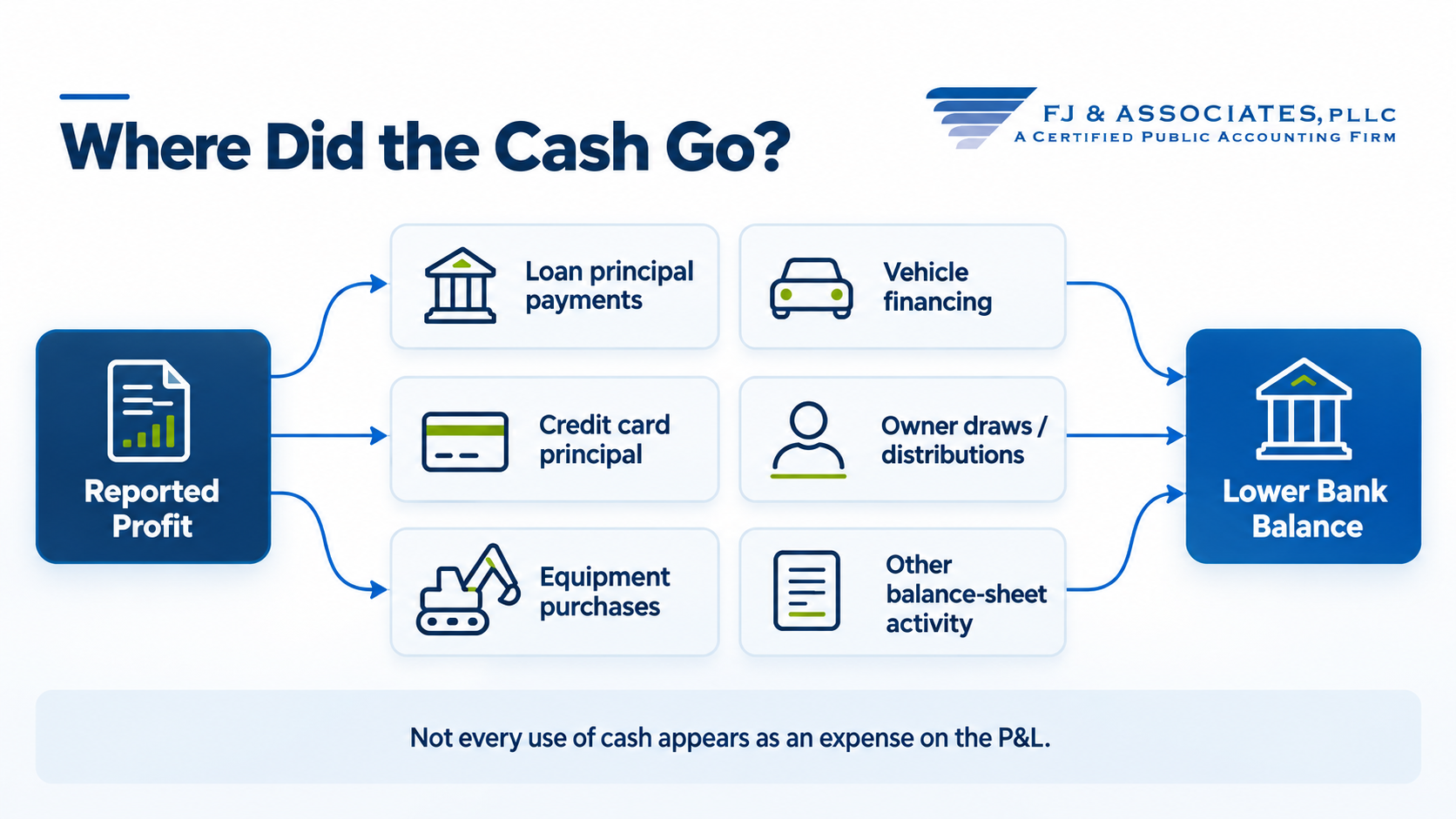
A business can report a healthy profit while using cash to pay down loans, make vehicle payments, reduce credit card balances, purchase assets, or distribute money to the owner.
That is why understanding your profit and loss statement is only one part of understanding your business.
Profit vs Cash Flow: What Your P&L Actually Measures
A profit and loss statement measures revenue and expenses over a period of time.
It answers:
“Did the business earn more than it spent on expenses?”
Your bank account answers a different question:
“How much cash is available right now?”How to Find Out Where the Cash Went.
Those two numbers will rarely match exactly.
The reason is simple: not every use of cash is an expense on the P&L.
That is where many business owners get confused.
Why Your Truck Payment Doesn’t Fully Appear on the P&L
Suppose your business is making payments on a truck.
You may write a check for $1,000 every month.
From a cash perspective, $1,000 left the bank account.
But from an accounting perspective, the entire $1,000 is not necessarily an expense.
A portion may reduce the loan principal on the balance sheet, while the interest portion is generally recorded as an expense.
That means the bank balance goes down by the full payment, but the P&L only reflects the expense portion.
The truck’s cost reaches the P&L gradually through depreciation, which is another reason profit and cash don’t line up.
Over 12 months, those cash payments can create a large difference between reported profit and cash remaining in the bank.
The Balance Sheet Tells the Rest of the Story
This is why business owners should not rely on the profit and loss statement alone.
The balance sheet provides the other half of the story.
It shows items such as:
- Loans
- Credit card balances
- Vehicles and equipment
- Cash
- Other assets
- Business liabilities
- Owner equity
If your P&L says you made $80,000 but you also paid down $20,000 of debt, that debt reduction affects cash even though the principal repayment does not reduce profit in the same way an operating expense does.
That difference matters.
Owner Draws Reduce Cash Without Reducing Profit
Another common reason cash disappears is owner withdrawals.
A business may earn a profit, but if the owner takes money out of the company throughout the year, the bank account naturally declines.
Depending on the entity type, those withdrawals may be classified as owner draws or distributions rather than business expenses.
That means they reduce cash without necessarily reducing the profit shown on the P&L.
So when someone says:
“My P&L says I made $80,000, but I only have $60,000. Where did the other $20,000 go?”
one of the first questions should be:
“How much did you take out of the business?”
Credit Card Payments Can Create the Same Disconnect
Credit cards can also create a disconnect between profit and cash.
Suppose your business has credit card balances that you are paying down each month.
The original purchases may already have been recorded as expenses when they occurred.
When you later make a payment against the credit card balance, the cash leaves your bank account, but the principal repayment is reducing a liability rather than creating a new expense.
Interest may still show up as an expense.
Again, cash goes down faster than profit.
Small Monthly Payments Add Up
Here’s a simple example.
A $200 payment may not feel significant.
But $200 every month equals $2,400 over a year.
Now add:
- A truck payment
- Two credit card payments
- A business loan
- Equipment financing
- Owner distributions
Individually, none of them may seem dramatic.
Together, they can explain why the company reports a healthy profit while the checking account remains close to zero.
Why You Need Profitability and Cash Flow Visibility
If you only look at the P&L, you may think:
“We’re profitable, so everything must be fine.”
If you only look at the bank account, you may think:
“We’re broke, so the business must be losing money.”
Both conclusions can be wrong.
You need both profitability and cash flow visibility.
Profit tells you whether the business model is working.
Cash flow tells you whether you have enough liquidity to continue operating.
Healthy businesses need both.
Profit doesn’t automatically create cash.
Profitability answers:
Are we earning more than our operating expenses?
Liquidity answers:
Do we have enough cash available to meet current obligations?
A business can be profitable and still have weak liquidity.
That can happen when cash is tied up in debt repayments, accounts receivable, equipment, inventory, or owner distributions.
The business may be successful on paper while still feeling financially tight month to month.
When Cash Flow Planning Becomes Important
Once a business reaches this stage, bookkeeping alone may not be enough.
The owner needs to understand where cash is going.
That means looking beyond the income statement and reviewing:
- Debt payments
- Owner distributions
- Credit card balances
- Equipment purchases
- Cash reserves
- Upcoming obligations
Cash flow planning helps explain what happened and what is likely to happen next.
When you need help forecasting and managing cash going forward, FJ & Associates’ fractional CFO services can help you plan for upcoming obligations and make informed cash decisions.
How to Find Out Where the Cash Went
If your P&L shows a profit but your bank account stays low, do not assume the accounting is wrong.
Start by reviewing the full financial picture.
- Look at the P&L.
- Look at the balance sheet.
- Review debt payments.
- Review owner distributions.
- Review major asset purchases.
- Review credit card balances.
- Then compare all of those items to the actual movement of cash.
- That process usually reveals the answer.
What If QuickBooks Doesn’t Match the Bank?
Sometimes the difference is not just debt payments, distributions, or asset purchases.
If QuickBooks does not match the bank activity, duplicate transactions or incomplete reconciliations may be distorting the books.
Software can make bookkeeping easier, but accurate reconciliations still require careful review.
A bookkeeping professional can identify duplicated revenue, duplicated expenses, missing transactions, and other issues before they affect financial decisions.
Profit Is an Accounting Measure. Cash Is Liquidity.
One of the most common financial misunderstandings among growing business owners is assuming profit equals cash.
It does not.
Profit is an accounting measure.
Cash is liquidity.
The two influence one another, but they move differently.
Once business owners understand that distinction, financial reports become much more useful.
Instead of asking:
“Where did the money go?”
they can begin asking:
“How is the business converting profit into cash?”
That is a much more strategic question.
Financial Clarity for Utah Business Owners
Business owners in Kaysville, Layton, Roy, Farmington, Riverdale, and Ogden often reach a point where financial statements become more complex than simply reviewing the bank balance.
As businesses add vehicles, loans, equipment, credit cards, employees, and owner distributions, the difference between profit and cash becomes more important.
At FJ & Associates, we help business owners understand not just what their financial statements say, but what those numbers mean for cash flow, taxes, and long-term growth.
Key Takeaways
Profit and cash are not the same thing.
Loan principal repayments reduce cash without appearing as an operating expense on the P&L.
Owner draws and distributions can reduce cash without reducing reported profit.
Credit card payments can also create differences between cash movement and expenses.
The balance sheet helps explain where cash went when the P&L alone cannot.
Business owners should review profitability and cash flow together.
Understand How Profit Becomes Cash
If your business made $80,000 but your bank account is nearly empty, that does not automatically mean something is wrong.
The answer may simply be sitting somewhere outside the profit and loss statement.
Debt repayments.
Vehicle payments.
Owner distributions.
Credit cards.
Asset purchases.
All of these can reduce cash without reducing profit in the same way operating expenses do.
The key is understanding how your P&L, balance sheet, and cash flow work together.
If your financial reports say one thing but your bank account seems to say another, FJ & Associates can help you understand where the money went and improve your financial visibility going forward.
FAQs
- Why does my P&L show profit but my bank account is empty?
- Because profit and cash flow measure different things. Cash may have been used for debt repayment, owner distributions, asset purchases, or other balance-sheet activity that does not appear as an operating expense on the P&L.
- Do loan payments count as business expenses?
- The principal portion of a loan payment generally reduces the loan balance rather than appearing as an expense on the P&L. Interest is generally treated differently and may be recorded as an expense.
- Do owner draws reduce business profit?
- Usually, owner draws or distributions reduce cash and equity rather than operating profit. The exact treatment depends on the entity structure.
- Why don’t credit card payments show up as new expenses?
- The underlying purchases may already have been recorded as expenses. Paying down the credit card principal reduces a liability rather than creating a second expense.
- What report shows business debt?
- Business loans and credit card balances generally appear on the balance sheet.
- What is the difference between profit and cash flow?
- Profit measures revenue minus expenses. Cash flow measures how money actually moves into and out of the business.
- Can a profitable business have cash flow problems?
- Yes. A profitable company can still experience low cash balances because of debt payments, asset purchases, slow customer collections, or owner withdrawals.
- What should I review if I cannot figure out where my cash went?
- Review the P&L, balance sheet, loan payments, owner distributions, credit cards, major purchases, and bank activity together.
Author Bio
Missy Dennis, CPA
Partner | FJ & Associates, PLLC | Kaysville, Utah
Missy holds a Master of Accounting degree from the University of Utah and is a licensed Certified Public Accountant.
She is committed to providing clear, accurate, and actionable guidance so clients can navigate complex financial decisions with confidence.
With more than twenty years of public accounting experience, Missy Dennis specializes in:
Tax preparation and tax advisory
Bookkeeping strategy alignment
Estate and trust taxation
Audit and consulting services
Low-income housing tax credits
Non-profit accounting
Small- and mid-sized business advisory

Leave a Reply
You must be logged in to post a comment.