

Employer payroll responsibilities don’t disappear when you outsource payroll. Hiring a payroll company is supposed to make running your business easier. Instead of calculating employee paychecks, tracking payroll taxes, preparing filings, and managing payment deadlines yourself, you hire professionals to handle those responsibilities. For many business owners, that’s a smart decision. Payroll is complicated, and working with an experienced payroll service provider can save time while reducing the risk of administrative errors.
But there’s one misunderstanding that can create serious problems: Hiring a payroll company does not automatically transfer your responsibility for payroll compliance to that company.
If payroll taxes aren’t paid, required filings are missed, or government notices go unanswered, the employer may still be responsible for resolving the problem. That’s why choosing a reliable payroll provider is only the first step. The second is making sure the work is actually being done correctly.
Quick Answer: If I hire a payroll company, am I still responsible for payroll mistakes and tax notices?
Generally, yes. Employers remain responsible for meeting applicable payroll tax and employment obligations, even when they hire a third-party payroll provider. The provider may be contractually responsible for performing certain services and may have obligations of its own, but that does not automatically eliminate the employer’s liability to tax agencies. If a payroll notice arrives, the business owner should make sure it is reviewed, addressed, and resolved.
Outsourcing payroll can reduce your workload. It does not mean you can ignore payroll entirely.
Watch: Who’s checking your payroll?
In this short video, FJ & Associates explains why employers need to oversee payroll and follow up when a provider is not resolving notices.
Why Business Owners Outsource Payroll in the First Place
Most business owners didn’t start their companies because they wanted to become payroll specialists. They started because they had a service to provide, a product to sell, or an opportunity they wanted to pursue. Then the business grows. The first employee is hired. Suddenly, the owner has responsibilities involving wages, withholding, payroll taxes, reporting deadlines, and employee records.
As more employees join, those responsibilities become more complicated. Payroll companies help by taking on many of the recurring administrative tasks associated with paying employees. Depending on the service agreement, a payroll provider may handle:
- Processing employee paychecks
- Calculating payroll withholding
- Preparing payroll tax filings
- Submitting payroll tax payments
- Maintaining payroll records
- Assisting with payroll-related notices
These services can provide substantial operational value. However, the business owner still needs to understand what the provider is responsible for and whether those responsibilities are being fulfilled.
Payroll Company Mistakes: What Happens When Something Goes Wrong?
Imagine you’ve hired a payroll provider to process employee wages and submit payroll taxes. Every pay period, the provider withdraws money from your business account. Employees receive their paychecks. Everything appears to be working. Then a notice arrives from a state tax agency. According to the notice, a payroll tax payment was not received or a required filing is missing.
Your first reaction might be: “That’s why I hired a payroll company. They should take care of it.” And you’re right to expect your provider to investigate an issue involving services it agreed to perform. But what happens if the provider doesn’t respond? What if the notice sits unanswered? What if additional penalties or interest begin accumulating?
The government agency generally looks to the employer responsible for the payroll obligation, subject to applicable law and the type of third-party arrangement. The fact that you hired someone to help does not necessarily remove your responsibility. That’s why business owners need to remain involved when payroll issues arise.
Payroll Tax Liability Doesn’t Automatically Disappear When You Outsource
There is an important distinction between delegating a task and transferring a legal obligation. When you hire a payroll company, you may authorize that company to calculate taxes, prepare returns, and submit payments on your behalf. But the underlying employer obligations generally remain with your business. For example, employer payroll tax responsibilities at the federal level can include withholding and remitting applicable income and employment taxes, making required employer tax payments, and filing employment tax returns.
Some third-party arrangements have specialized legal rules that may affect how responsibilities and liabilities are allocated. For that reason, the exact treatment depends on the provider arrangement and applicable law. Still, business owners should not assume that hiring a payroll company means the IRS or a state agency will automatically pursue only the provider if something goes wrong.
The safest approach is to maintain oversight of the obligations your business is required to meet.
For federal rules and exceptions, see the IRS guidance on outsourcing payroll and third-party payers and Publication 15, Section 16.
Never Ignore a Payroll Tax Notice
One of the most important points from the video is what happens when notices arrive. Business owners sometimes assume a payroll notice is simply a routine issue that their payroll company will automatically resolve. Sometimes that’s exactly what happens. A payment may have been applied incorrectly. An agency may not have matched a filing to the correct account.
IRS payroll notices and state payroll tax notices may reflect a timing difference or an administrative error. But the business owner shouldn’t assume the issue is resolved simply because the notice was forwarded. A notice may contain a response deadline, a balance due, a filing request, or information about possible penalties. Ignoring it can make the situation more complicated. Unresolved filing or payment issues may lead to payroll tax penalties and interest, depending on the circumstances.
What Should You Do When a Payroll Notice Arrives?
Start by reviewing the notice carefully. Identify which agency sent it, which tax period it concerns, and whether there is a deadline for responding. Then contact your payroll provider and provide a complete copy. Ask the provider to investigate the issue and explain what happened. If the provider believes a payment or filing was submitted correctly, request supporting documentation.
That may include payment confirmations, filing acknowledgments, or other relevant records. Most importantly, follow up. Don’t assume the problem has been resolved until you have confirmation that the issue has actually been addressed.
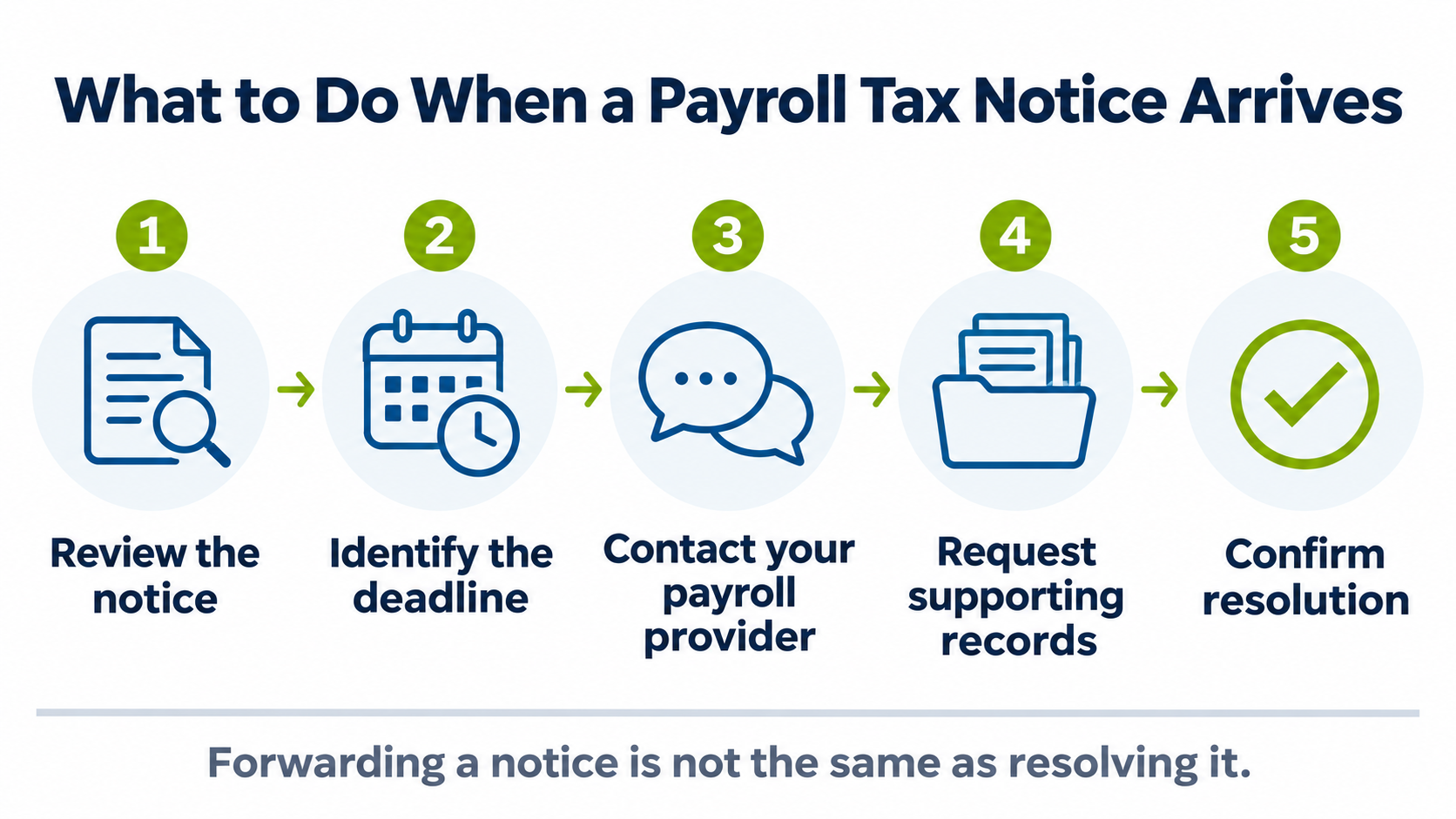
If the provider is unresponsive or the notice raises a significant compliance issue, consider involving your CPA or another qualified payroll tax professional.
What If Your Payroll Provider Isn’t Fixing the Problem?
This is where the business owner’s responsibility becomes especially important. A payroll company may be excellent at processing regular payroll but slow to respond when something unusual happens. Perhaps a notice has been forwarded multiple times. Maybe the provider says it’s working on the issue but cannot provide an update. Or perhaps you continue receiving notices for the same tax period.
At that point, the business owner needs to take a more active role. That might mean escalating the issue to the provider’s management team, requesting records, contacting the agency through the appropriate channels, or bringing in another professional. In some situations, it may also be appropriate to evaluate whether the current payroll provider remains a good fit.
The goal isn’t to blame someone immediately. It’s to make sure the employer’s obligations are being handled correctly and the problem doesn’t continue.
Payroll Management and Payroll Provider Accountability
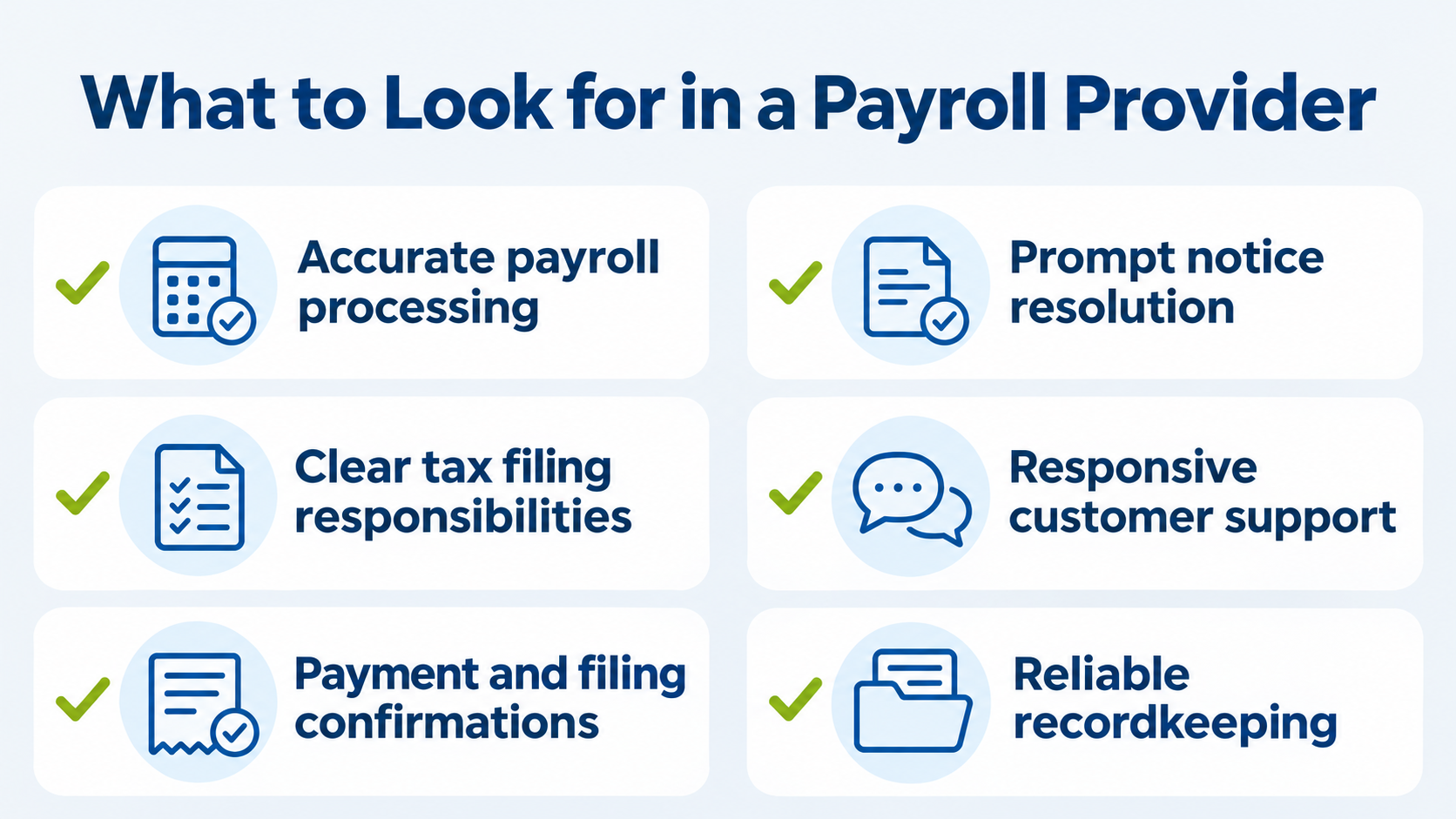
A good payroll relationship should involve more than paychecks arriving on time. Business owners should have reasonable visibility into the services they’re paying for. That doesn’t mean reviewing every payroll calculation personally. It means having a process for confirming that important obligations are being completed. For example, ask yourself:
Are employees being paid accurately and on time?
If employees regularly report incorrect wages, deductions, or missing payments, those issues deserve attention.
Are required payroll filings being completed?
Your provider should be able to explain which filings it handles and how you can obtain copies or confirmations.
Are payroll taxes being submitted to the correct agencies?
You should understand how tax payments are funded and what records demonstrate that payments were made.
Does the provider respond promptly to notices?
An effective provider should have a clear process for investigating payroll tax correspondence.
Can you get answers when something goes wrong?
Communication matters, particularly when deadlines or penalties are involved. If you cannot obtain clear answers to these questions, it may be time to review your payroll arrangement.
Choosing the Right Payroll Provider: Service Matters More Than Size
The video also raises an important point about boutique payroll providers. Smaller payroll companies can offer a more personal experience. Business owners may appreciate having a dedicated contact who understands their company, employees, and recurring payroll needs. Larger providers may offer extensive technology platforms, standardized processes, and additional service capabilities. Neither model is automatically the best choice for every business.
A smaller provider isn’t necessarily more accurate simply because it offers personalized service. And a larger provider isn’t necessarily more reliable simply because it has more resources. What matters is whether the provider can consistently perform the work your business needs. Before choosing a payroll company, consider its experience, communication practices, reporting capabilities, tax filing procedures, notice-resolution process, and support availability.
Ask what happens when something goes wrong. A provider’s response to that question may tell you more than its sales presentation.
The Hidden Risk of Assuming Payroll Is Completely Hands-Off
Payroll outsourcing is often marketed around convenience. And convenience is valuable. But there’s a difference between reducing administrative work and eliminating oversight. Consider a business owner who never reviews payroll reports or confirms that tax obligations are being completed. For months, everything may appear normal. Then an agency notice arrives. The owner discovers that an issue has existed for several reporting periods.
Now the problem may involve multiple filings, payments, and correspondence records. A simple oversight process could potentially have identified the issue earlier. That doesn’t mean the business owner needs to become a payroll expert. It means payroll should be treated like other important business functions. You can delegate the work while maintaining appropriate management oversight.
What Do Employer Payroll Responsibilities Look Like in Practice?
For many small businesses, payroll oversight doesn’t need to be complicated. It can begin with a few consistent habits.
- Review payroll summaries for unusual changes.
- Know which agencies receive your payroll taxes.
- Understand who is responsible for filing returns and submitting payments.
- Keep copies of important payroll records.
- Forward government notices promptly.
- Follow up until issues are resolved.
- Periodically review the services your payroll provider is performing.
These steps help business owners remain informed without taking over the day-to-day payroll process. As the business grows or operates in multiple states, additional oversight may be necessary.
Payroll Compliance for Small Businesses as They Grow
Hiring employees is an important milestone. It also introduces ongoing financial and legal responsibilities. A business with one employee may have a relatively straightforward payroll process. A business with employees in several states, multiple pay types, or more complex benefits arrangements may have additional requirements. Different jurisdictions can have different rules for withholding, unemployment insurance, wage reporting, and other employer obligations.
That complexity is one reason professional payroll support becomes valuable. But it’s also why business owners should understand the scope of their provider’s services. If a payroll company only handles certain states, certain filings, or certain tax accounts, the employer needs to know who handles everything else. Gaps in responsibility can create problems even when each individual provider believes it’s doing its assigned work.
When Should You Consider Changing Payroll Providers?
Not every payroll mistake means you need to find a new company. Errors can occur even with experienced professionals. What matters is how the provider responds. If an issue is identified quickly, explained clearly, and corrected appropriately, that may demonstrate a functioning support process. But recurring errors, unexplained tax notices, missed deadlines, or prolonged lack of communication deserve closer attention.
A provider change may be worth considering when you consistently cannot obtain the information or support your business needs. Before transitioning, make sure payroll records, tax account information, filing history, and payment confirmations are properly transferred. Changing providers without coordinating responsibilities can create additional reporting or payment problems.
Small Business Payroll Services in Kaysville, Layton, and Roy
For business owners comparing payroll services in Kaysville, Utah, payroll services in Layton, Utah, or payroll services in Roy, Utah, the priority is the same: dependable processing and clear responsibility for taxes, filings, and notices. Small business payroll in Utah also requires a provider who understands the scope of your operations, including any employees working in other states. They want employees paid correctly. They want payroll taxes handled on time. They want notices addressed before small issues become larger problems. And they want to spend less time managing administrative work. At FJ & Associates, we understand that business owners need dependable financial and payroll support.
Our goal is to help business owners stay informed, maintain organized records, and understand their responsibilities while working with the professionals supporting their operations. Whether you’re hiring your first employee, reviewing your current payroll arrangement, or dealing with an unresolved notice, knowing who is responsible for each part of the process is an important starting point.
Whether you are evaluating a payroll company in Davis County, looking for payroll services in Ogden, or working with a business accountant in Farmington, Utah, ask who will handle each filing, payment, and agency notice. A CPA in Kaysville, Utah, can help you review your payroll processes and identify gaps in provider responsibilities. Learn more about FJ & Associates payroll services or contact our team to discuss your business.
Key Takeaways
- Outsourcing payroll doesn’t automatically eliminate employer liability. Your business generally remains responsible for applicable payroll tax and employment obligations.
- Payroll notices require follow-up. Forwarding a notice to your provider isn’t the same as confirming resolution.
- Choose providers based on reliability. Accuracy, responsiveness, and clear processes matter more than company size.
- Maintain reasonable oversight. Business owners should know which filings and payments their providers handle.
- Escalate unresolved issues. If your provider isn’t addressing a problem, take action before deadlines or additional penalties become concerns.
- Review your arrangement as you grow. More employees and additional jurisdictions can increase payroll complexity.
Conclusion
Running a business comes with responsibilities that don’t disappear simply because you hire someone else to help. Payroll is one of them. A professional payroll company can take significant work off your plate. It can help process wages, prepare filings, and manage recurring payroll tasks. But as the employer, you still need to make sure those obligations are being handled.
When a notice arrives, pay attention. When something doesn’t look right, ask questions. When your provider isn’t resolving an issue, follow up and take action. And when choosing a payroll company, look for professionals who are accurate, responsive, and capable of supporting your business. If you’re uncertain whether your payroll obligations are being handled correctly, FJ & Associates can help you review your payroll processes and identify areas that may need attention.
Frequently Asked Questions
-
If I hire a payroll company, am I still responsible for payroll taxes?
Generally, yes. Employers typically remain responsible for applicable payroll tax obligations even when a third party processes payroll. Certain specialized third-party arrangements may have different rules, so the details of your agreement matter.
-
What happens if my payroll company fails to pay payroll taxes?
The employer may still face unpaid tax obligations, penalties, or interest, depending on the circumstances and applicable law. Contact the provider promptly, obtain payment and filing records, and seek qualified assistance when necessary.
-
Should I respond to a payroll tax notice if my provider handles payroll?
Yes. You should ensure the notice is reviewed and addressed, even if the provider prepares the response. Keep track of deadlines and obtain confirmation of resolution.
-
Can my payroll company be held responsible for its mistakes?
Possibly. Responsibility between the employer and provider can depend on the service contract, the type of error, and applicable law. A provider’s contractual obligations do not necessarily eliminate the employer’s liability to tax agencies.
-
How do I know whether payroll taxes are being paid correctly?
Request filing and payment confirmations from your provider and, where available, verify relevant tax account activity directly with the applicable agencies.
-
Is a boutique payroll provider better than a large payroll company?
Not necessarily. Smaller providers may offer personalized service, while larger providers may have broader systems and resources. Accuracy, communication, experience, and reliable support should guide the decision.
-
What should I do if my payroll provider ignores a tax notice?
Escalate the issue, request supporting records, and consider contacting the agency or involving a qualified professional before the response deadline passes.
-
How often should business owners review payroll reports?
At minimum, owners should establish a regular review process appropriate to their payroll volume and complexity. Reviewing each payroll summary and periodically confirming tax filings and payments can help identify issues.
-
Can I change payroll companies if I’m unhappy with the service?
Yes. However, transitions should be carefully coordinated so payroll records, tax payments, and filing responsibilities are properly handled.
-
Can a CPA help with payroll tax notices?
Yes. Depending on the issue and scope of services, a CPA can help review payroll records, investigate discrepancies, explain notices, and assist with appropriate next steps.
About the Author
Missy Dennis, CPA
Partner | FJ & Associates, PLLC | Kaysville, Utah
Missy holds a Master of Accounting degree from the University of Utah and is a licensed Certified Public Accountant. With more than 20 years of public accounting experience, Missy provides practical financial and tax guidance to individuals, business owners, and organizations. Her areas of expertise include:
- Tax preparation and advisory
- Bookkeeping strategy alignment
- Estate and trust taxation
- Audit and consulting services
- Low-income housing tax credits
- Nonprofit accounting
- Small- and mid-sized business advisory
Missy is committed to helping clients understand their financial responsibilities and make informed decisions with greater confidence.
