

For years, the arithmetic of a 4% deal started in the same place: could you get tax-exempt bonds to cover at least half the cost of the building and the land under it?
If you could, the deal did not have to compete for your state’s scarce 9% housing credit allocation. If you could not, you were back in a competitive round with far more applicants than credits.
That threshold has changed. Buildings can now qualify at 25% rather than 50% — but not automatically, and not on the date most summaries suggest. The statute attaches two conditions, and a deal that misses either one is still governed by the old 50% test.
Here is what the law actually says, and what it means for a project already in motion.
What the statute says now
The relevant provision is IRC § 42(h)(4)(B). It governs when the credit on a bond-financed building escapes § 42(h)(1) — the rule that credit must be allocated by the state housing credit agency out of its capped annual ceiling.
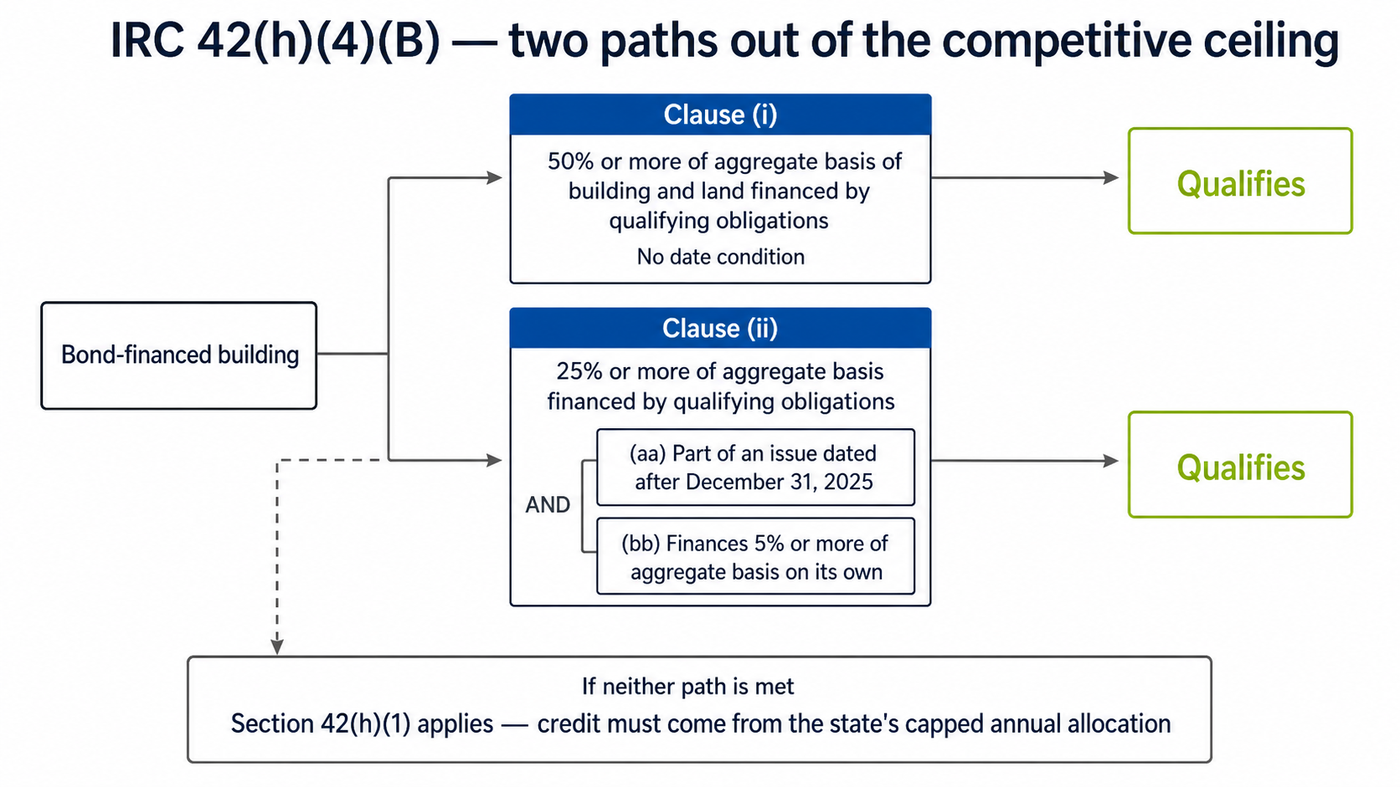
The provision now offers two independent paths:
(i) 50 percent or more of the aggregate basis of such building and the land on which the building is located is financed by 1 or more obligations described in subparagraph (A), or
(ii) (I) 25 percent or more of the aggregate basis of such building and the land on which the building is located is financed by 1 or more obligations described in subparagraph (A), and
(II) 1 or more of such obligations —
(aa) are part of an issue the issue date of which is after December 31, 2025, and
(bb) provide the financing for not less than 5 percent of the aggregate basis of such building and the land on which the building is located.
Read that structure carefully, because it is doing more work than a headline can carry.
The two conditions inside the 25% test
Most write-ups compress this to “the threshold dropped to 25%.” The codified test carries two specific conditions that a one-line summary cannot hold.
First: clause (aa) turns on the bond issue date. The issue must be dated after December 31, 2025. An older issue does not qualify under clause (ii) no matter how large it is — though a deal that clears 50% still qualifies under clause (i), where no date condition applies.
Second: there is a 5% floor inside the 25% test. Clause (bb) requires that the post-2025 issue finance at least 5% of aggregate basis on its own. You cannot satisfy the new test by layering a token new issue on top of older bonds and adding the percentages up to 25. At least one qualifying issue has to be dated after 2025 and carry 5% or more of aggregate basis by itself.
Both conditions have to hold. Miss either, and clause (ii) is unavailable.
One point to confirm before you rely on it
The conditions above are the codified text of § 42(h)(4)(B), and they speak to the issue date of the obligations. Placed-in-service date does not appear in that subparagraph.
Separately, much of the professional commentary describes the change as applying to buildings placed in service after December 31, 2025 — which would come not from § 42 itself but from the effective-date provision of the amending act (P.L. 119-21, § 70422). We were not able to verify that provision’s exact wording against a primary source for this article, and the secondary summaries are not consistent with one another on the point.
The practical takeaway: do not treat “placed in service after 2025” and “bonds issued after 2025” as interchangeable, because they are not, and a deal can easily satisfy one and not the other. A structure that meets both readings carries no exposure on the question. For anything closer to the line, read § 70422’s effective-date subsection directly, or have counsel confirm it, before it drives a financing decision.
And the 50% test did not go away. Clause (i) remains in the statute, unconditional and with no date restriction. A deal that clears 50% still qualifies on that basis alone, whenever its bonds were issued. The 25% path is an addition, not a replacement — which matters for deals structured before the change and for anyone reading an older term sheet.
Why the threshold moves the economics
The reason the bond test carries so much weight has nothing to do with the bonds themselves. It is about which pot the credit comes from.
Meet the test, and § 42(h)(1) does not apply — the credit is not drawn from the state’s capped allocation, so the project is not competing against every other application in the round. Miss it, and the project needs a competitive allocation from a supply that is fixed by formula.
That supply is set annually. For calendar year 2026, under Rev. Proc. 2025-32, § 4.08, the amount used to calculate the state housing credit ceiling is the greater of:
| 2026 figure | Amount | Source |
|---|---|---|
| Per-population multiplier | $3.416 × state population | Rev. Proc. 2025-32, § 4.08 |
| Small-state minimum | $3,953,600 | Rev. Proc. 2025-32, § 4.08 |
| Per low-income unit qualified basis, § 42(e)(3)(A)(ii)(II) | $8,700 | Rev. Proc. 2025-32, § 4.07 |
Those ceiling figures reflect the increase enacted in the One Big Beautiful Bill Act, which raised the state ceiling for calendar years beginning after December 31, 2025. If you are working from a 2025 planning file, the older per-capita and small-state figures will understate 2026 capacity — worth re-checking before anyone relies on a carryforward estimate.
The practical effect of a lower bond threshold is that the same volume of private activity bonds can support more projects. Bond capacity, not the credit ceiling, becomes the binding constraint on a larger share of 4% deals.
What the change does not touch
It is worth being precise about the boundaries, because a financing-threshold change tends to get read as broader relief than it is.
- Compliance obligations are unchanged. The 15-year compliance period, the extended use agreement, income and rent restrictions, and annual certification requirements all operate exactly as before.
- Placed-in-service and basis rules are unchanged. Eligible basis, applicable fraction, and the placed-in-service determination follow the same rules.
- Audit and reporting requirements are unchanged. A partnership that needed an audited financial statement, a cost certification, or a HUD-program audit still needs one.
- The volume cap still exists. Private activity bonds remain subject to § 146. A lower LIHTC threshold does not create bond capacity; it changes how far the existing capacity stretches.
In other words, this changes what it takes to qualify a deal — not what it takes to keep it qualified.
What it means for Utah sponsors
Utah’s housing credits are allocated by Utah Housing Corporation, which publishes a Qualified Allocation Plan governing how credits are awarded. Sponsors should read the current QAP directly rather than assume the agency’s application requirements track the federal change on the same timeline — allocating agencies set their own submission standards, deadlines, and underwriting thresholds, and those do not update automatically when the Code does.
The federal test tells you whether a deal can proceed outside the competitive ceiling. The QAP tells you what the agency will require to process it. Both have to be satisfied, and only one of them changed.
What to check on a deal already in progress
If you have a transaction structured against the 50% test, five questions are worth answering before anything is re-underwritten:
- What is the issue date of each series, and what is the projected placed-in-service date? Only issues dated after December 31, 2025 support clause (ii) — and confirm the amending act’s applicability provision separately, since commentary frames it around placed-in-service date.
- What share of aggregate basis does the post-2025 issue carry on its own? The 5% floor is tested against that issue, not the stack.
- How is aggregate basis being measured? The test runs on the building and the land on which it is located — a land figure that drifts moves the percentage.
- Does the deal still clear 50% anyway? If so, clause (i) is the simpler path and carries no date condition.
- Has the allocating agency’s process caught up? A deal that qualifies federally can still stall on an application requirement.
That last one is where transactions tend to lose time. The federal arithmetic is usually the easy part.
How FJ & Associates works on these engagements
Affordable housing is one of the areas where our audit practice is deepest. We perform audits for entities across the affordable housing sector — see our Assisted Housing Audits practice — and low-income housing tax credits have been part of this firm’s work for years, alongside our broader financial audit and governmental audit engagements.
On a LIHTC engagement that typically means cost certifications, partnership audits, and the annual reporting a syndicator or allocating agency expects — work that sits on the assurance side of the practice rather than the tax planning side, though the two meet on basis and timing questions. LIHTC also appears in our broader guide to federal and Utah business tax credits.
Our audit quality control is overseen by Douglas Child, and the firm works from Kaysville with additional offices in Roy, Tulsa, and Westerly.
This article describes federal statutory provisions as of publication and is general information, not tax or legal advice for any specific transaction. LIHTC structuring decisions depend on facts this article cannot know. Confirm the current text of § 42 and your allocating agency’s requirements before relying on any threshold for an actual deal.
Frequently asked questions
Did the 50% bond test get repealed?
No. IRC § 42(h)(4)(B)(i) still provides that a building qualifies if 50% or more of the aggregate basis of the building and land is financed by qualifying obligations. It carries no issue-date condition. The 25% test is an alternative path, not a replacement.
What exactly triggers the 25% test?
Two things together: at least 25% of aggregate basis financed by qualifying obligations, and at least one such obligation that is (a) part of an issue dated after December 31, 2025 and (b) financing at least 5% of aggregate basis on its own.
Does my building’s placed-in-service date matter for the 25% test?
The codified test in § 42(h)(4)(B)(ii) refers to the issue date of the obligations, not the placed-in-service date. However, much professional commentary describes the change as applying to buildings placed in service after December 31, 2025 — a condition that would come from the amending act’s effective-date provision rather than from § 42. Treat the two dates as separate requirements and confirm the applicability provision before relying on either alone.
Can I combine older bonds with a small new issue to reach 25%?
Only if at least one post-2025 issue independently finances 5% or more of aggregate basis. The 5% floor is measured against that issue.
What is “aggregate basis” measured against?
The statute refers to the aggregate basis of the building and the land on which the building is located. Land is included, which is why land valuation changes can move the percentage.
Does this change LIHTC compliance requirements?
No. The compliance period, extended use agreement, income and rent restrictions, and annual certifications are unaffected.
How much housing credit can a state allocate in 2026?
Under Rev. Proc. 2025-32, § 4.08, the calendar year 2026 state housing credit ceiling is calculated as the greater of $3.416 multiplied by state population, or $3,953,600.
Who allocates housing credits in Utah?
Utah Housing Corporation, under a Qualified Allocation Plan it publishes. Confirm current-year requirements with the agency, as agency processes are separate from the federal test.
Author
Missy Dennis, CPA
Partner | FJ & Associates, PLLC | Kaysville, Utah
Missy holds a Master of Accounting degree from the University of Utah and is a licensed Certified Public Accountant. With more than twenty years of public accounting experience, her practice includes low-income housing tax credits, non-profit accounting, estate and trust taxation, audit and consulting services, and tax advisory for small- and mid-sized businesses.
Sources
- IRC § 42(h)(4) — 26 U.S. Code § 42 (statutory text quoted above), cross-checked against uscode.house.gov
- Rev. Proc. 2025-32, §§ 4.07–4.08 — Internal Revenue Bulletin 2025-45
- Utah Housing Corporation — state housing credit allocating agency, Qualified Allocation Plan
