

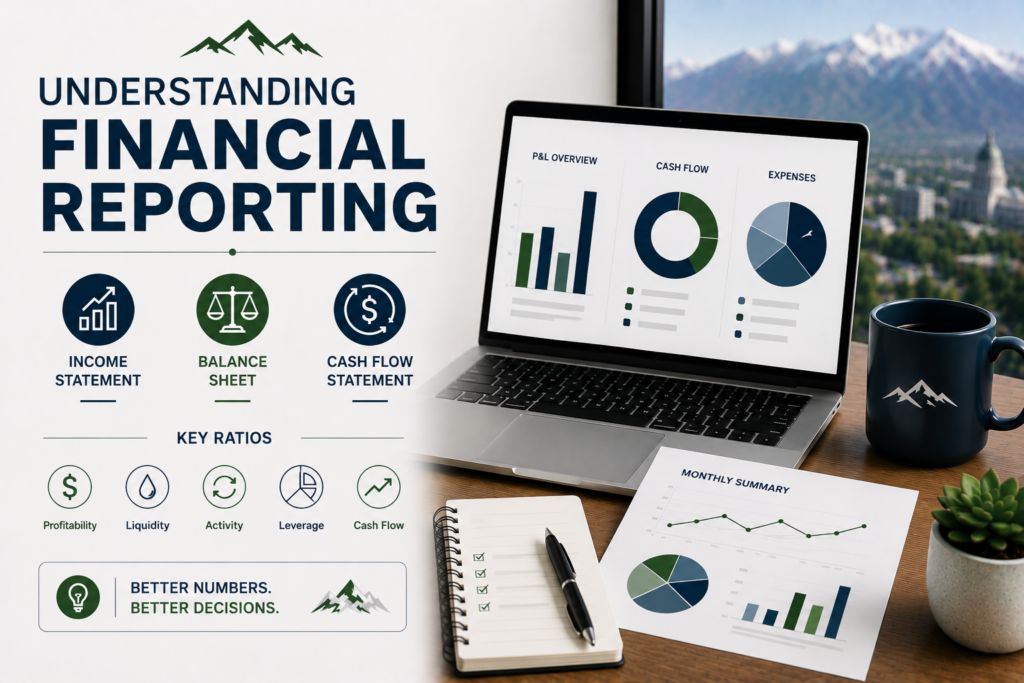
 Financial statements exist to answer specific questions about your business’s financial condition. The problem is that most business owners receive these reports, glance at the bottom line, and move on — missing the insights that would actually change how they run their business.
This guide explains the three core financial statements, what each one tells you, how to read them together, and which numbers matter most for running a small business intelligently.
Want financial reports that actually tell you something? Call (801) 927-1337 or email admin@cpaone.net.
The Three Core Financial Statements
1. Income Statement (Profit & Loss Statement)
The P&L reports revenue, expenses, and net income for a specific period — a month, a quarter, or a year. It answers the question: Did we make money during this period?
Key line items:
- Revenue (top line): Total sales or service income
- Cost of Goods Sold (COGS): Direct costs of producing what you sell — materials, direct labor
- Gross Profit: Revenue minus COGS. Gross margin % = Gross Profit ÷ Revenue
- Operating Expenses: Overhead — rent, admin salaries, insurance, marketing
- Operating Income (EBIT): Gross profit minus operating expenses. Measures core business performance before financing costs and taxes
- Net Income (bottom line): Operating income minus interest expense and taxes
What to look for:
- Is gross margin stable or eroding? Declining gross margin signals pricing problems or rising direct costs
- Are operating expenses growing faster than revenue? Fixed cost creep reduces operating leverage
- Is net income positive — and is it enough to justify the risk of owning the business?
2. Balance Sheet
The balance sheet is a snapshot of your financial position on a specific date. It answers: What do we own, what do we owe, and what’s left for the owners?
Structure:
- Assets: What the business owns (cash, receivables, inventory, equipment, property)
- Liabilities: What the business owes (accounts payable, credit cards, loans, deferred revenue)
- Equity: The owner’s residual interest (assets minus liabilities)
Key relationships to monitor:
- Current Ratio: Current Assets ÷ Current Liabilities. A ratio above 1.0 means current assets exceed current liabilities — the business can cover near-term obligations. Below 1.0 signals liquidity risk
- Debt-to-Equity Ratio: Total Liabilities ÷ Total Equity. Higher ratios mean more leverage; lenders scrutinize this
- Accounts Receivable: Is your AR balance growing relative to revenue? Rising AR without rising revenue means collections are slowing
3. Statement of Cash Flows
The cash flow statement reconciles net income to actual cash movement. It answers: Where did the cash come from and where did it go?
See our dedicated cash flow management guide for a full explanation of how to read and use the cash flow statement.
Reading the Three Statements Together
The real insight comes from reading all three together. A few examples:
High profit but low cash: Your P&L shows strong profit but your bank account is thin. Look at the balance sheet — is AR growing? Inventory building? Are you making large loan repayments? The cash flow statement will show exactly where the cash went.
Strong cash but declining profit: If cash is building but the P&L shows declining profit, you may have deferred expenses, are drawing down on a credit line, or received a large deposit for work not yet performed (deferred revenue on the balance sheet).
Growing revenue but shrinking equity: If revenue is increasing but equity is declining, owner distributions are exceeding net income — the owner is drawing more than the business earns. This is common and manageable if intentional; dangerous if undetected.
Key Financial Ratios for Small Business Owners
Beyond the statements themselves, ratios express relationships that tell you how efficiently your business is operating:
Profitability Ratios
- Gross Margin % = Gross Profit ÷ Revenue. Industry benchmarks vary widely; track your own trend
- Net Profit Margin % = Net Income ÷ Revenue
- EBITDA Margin % = EBITDA ÷ Revenue (used for business valuation)
Liquidity Ratios
- Current Ratio = Current Assets ÷ Current Liabilities (target: above 1.2)
- Quick Ratio = (Cash + AR) ÷ Current Liabilities (excludes inventory; more conservative)
Activity Ratios
- Days Sales Outstanding (DSO) = (AR ÷ Revenue) × Number of Days. How long it takes to collect; compare to your stated payment terms
- Inventory Turnover = COGS ÷ Average Inventory. Higher is better; low turnover = slow-moving inventory
- Days Payable Outstanding = (AP ÷ COGS) × Days. How long you take to pay vendors; managing this can improve cash flow
Leverage Ratios
- Debt-to-Equity = Total Liabilities ÷ Equity
- Debt Service Coverage Ratio (DSCR) = EBITDA ÷ Annual Debt Service. Lenders require DSCR above 1.25; below 1.0 means the business cannot service its debt from operating income
We build monthly KPI dashboards that surface these ratios alongside your financial statements, making them actionable rather than academic. See our KPI tracking services.
How Often Should You Review Financial Reports?
Monthly:
- P&L vs. prior month
- P&L vs. budget
- AR aging (what’s outstanding and how old)
- Cash position and forecast
Quarterly:
- Balance sheet review
- Year-to-date budget comparison
- Cash flow statement
- KPI trend analysis
Annually:
- Full-year P&L vs. prior year
- Balance sheet trend (comparing year-end over multiple years)
- Business valuation benchmark
- Tax planning review with your CPA
Business owners who review financials monthly make better, faster decisions and are better prepared for lender and investor conversations.
Management Reports vs. Tax Returns
 Your financial statements prepared for management decision-making (management reports) may differ from your tax return — and this is normal and expected. Common differences:
- Depreciation: financial statements use straight-line; tax returns often use MACRS or bonus depreciation
- Timing of revenue and expense recognition (particularly for accrual-basis businesses)
- Owner compensation: your “salary” on a tax return may be structured differently than on management reports
Your CPA can explain the differences between your management reports and your tax return — they both serve different purposes and both are correct within their respective frameworks.
Financial Reports That Actually Drive Decisions
Numbers on a page don’t help your business — understanding what they mean does. FJ & Associates builds the financial reporting infrastructure and delivers the monthly context that turns data into decisions.
Call (801) 927-1337 | Email admin@cpaone.net | 612 N Kays Dr Suite 120, Kaysville, UT 84037
Missy Dennis, CPA | Partner | FJ & Associates, PLLC | Kaysville, Utah. Missy holds a Master of Accounting degree from the University of Utah and is a licensed Certified Public Accountant. She is committed to providing clear, accurate, and actionable guidance so clients can navigate complex financial decisions with confidence. With more than twenty years of public accounting experience, Missy Dennis specializes in: Tax preparation and tax advisory; Bookkeeping strategy alignment; Estate and trust taxation; Audit and consulting services; Low-income housing tax credits; Non-profit accounting; Small- and mid-sized business advisory.
