


But there’s a difference between feeling like the business had a good month and knowing it had a good month. That’s where the monthly financial close becomes important. Closing the books each month gives you a consistent point to evaluate results. A monthly close gives business owners a consistent opportunity to review financial performance, understand what happened, and make informed decisions about what comes next. Without it, companies can spend months operating without reliable information about their profitability, cash position, or progress toward financial goals.
And that lack of visibility can affect much more than bookkeeping. It can influence business strategy, lender reporting, cash management, and even the ability to make meaningful tax planning decisions before year-end.
Quick Answer: What Happens If You Don’t Close Your Books Every Month?
When a business doesn’t complete its monthly financial close, financial reports may become outdated or unreliable. That can make it harder to evaluate profitability, monitor cash flow, measure performance against goals, meet lender reporting requirements, and prepare accurate tax projections. The longer financial reporting falls behind, the more difficult it becomes to make decisions based on current information.
A consistent monthly close helps business owners understand where they stand while there’s still time to act.
Watch: Why the Monthly Close Matters
What Is a Monthly Financial Close?
A monthly financial close, also called a month-end close, is the process of reviewing and finalizing a company’s accounting records for a particular month. The month-end close process helps ensure that transactions have been recorded, accounts have been reconciled, and financial statements reasonably reflect the company’s activity. Depending on the business, the process may involve reviewing bank accounts, credit cards, payroll, accounts receivable, accounts payable, loan balances, and other accounting activity.
It can also include recording necessary adjustments, reviewing unusual transactions, and preparing financial reports. The goal isn’t simply to finish entering transactions. It’s to produce financial information that management can actually use. For many businesses, small business financial statements include the profit and loss statement, balance sheet, and cash flow information. Profit and loss reporting helps explain operating results; the other reports add context about financial position and liquidity. Together, these reports help owners understand profitability, financial position, and liquidity.
Without a consistent closing process, those reports may be incomplete or misleading.
The IRS explains how good records help owners monitor business progress and prepare financial statements. A consistent close turns those records into information for management.
How Do You Win Next Month If You Don’t Know Whether You Won Last Month?
Consider what happens when you start a month without reliable results from the previous one. Imagine your business sets a monthly revenue goal of $150,000. You also establish a profitability target because you want to make sure increased sales are producing meaningful financial results. The month ends. Employees are busy. Customers seem satisfied. The business feels productive.
But no one has finalized the financial statements. You don’t know whether revenue reached the target. You don’t know whether expenses exceeded expectations. You don’t know whether profitability improved or declined. Now you’re entering another month without understanding the previous one. How do you know what needs to change? You might decide to increase marketing spending when the real problem is rising labor costs.
You might delay hiring because cash feels tight, even though the underlying financial reports would support a different decision. Or you might assume the company had a strong month when higher expenses actually reduced profitability. A completed monthly close gives you a starting point for answering those questions.
Financial Goals Need Reliable Measurements
Many growing businesses establish financial targets. Those targets might include revenue, gross profit, operating profit, EBITDA, or cash flow. But setting a goal is only useful when you can measure the result. Suppose a company misses its monthly profit target. With timely financial statements, management can investigate why. Was revenue lower than expected? Did payroll increase?
Were material costs higher? Did a major expense occur that wasn’t included in the budget? Understanding the cause helps the owner decide what to do differently. Without current reports, those decisions become educated guesses. The monthly close creates a regular feedback process.
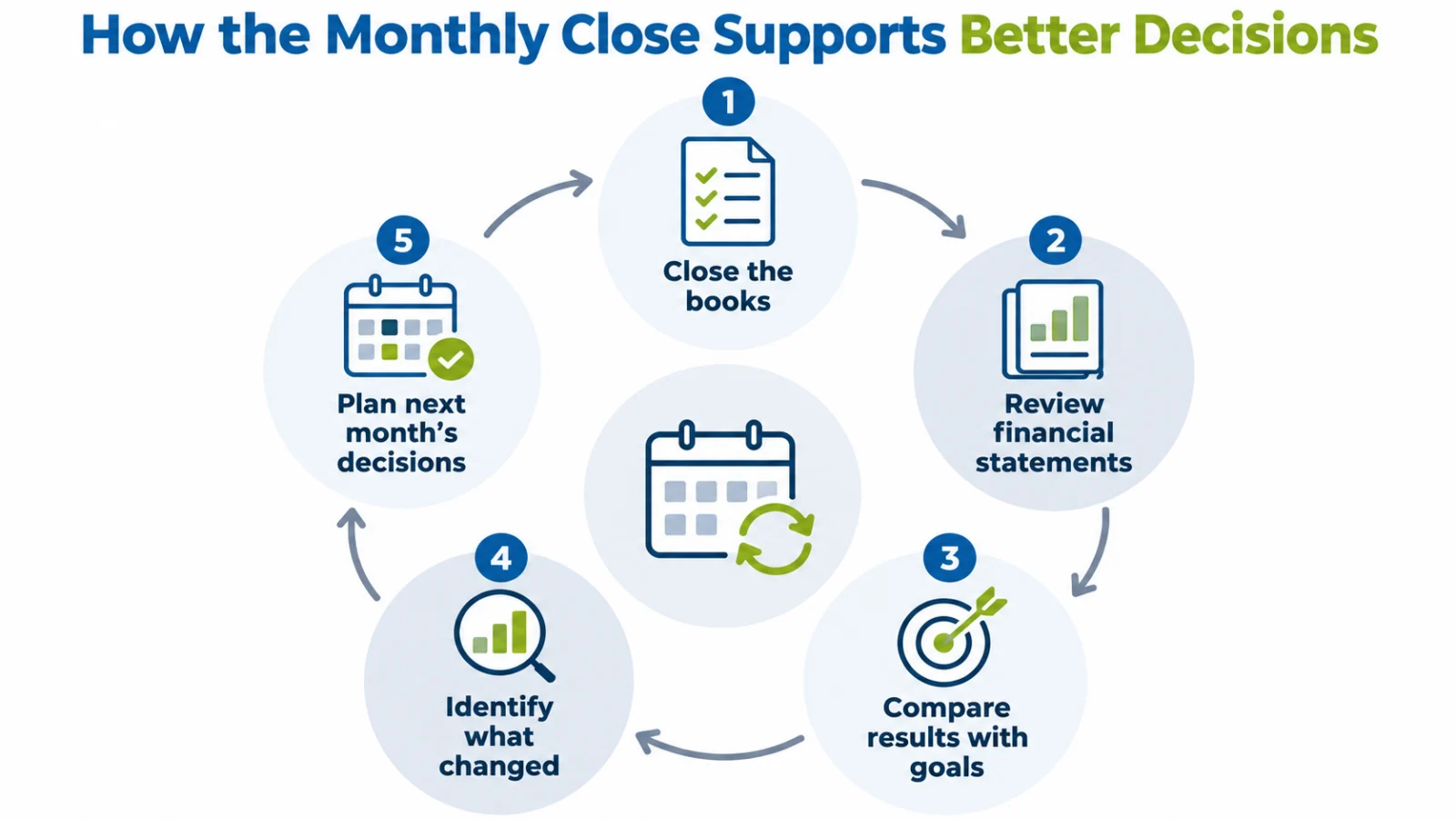
It allows business owners to evaluate results while the operational details are still fresh.
Your Cash Position Can Become Harder to Understand
Another major problem with delayed financial reporting is reduced cash visibility. A business can appear profitable while experiencing cash flow pressure. For a closer look at that distinction, read why profit and cash flow can tell different stories. Customers may be slow to pay. Loan payments may be reducing available cash. Inventory purchases may be consuming working capital. Or operating expenses may be increasing faster than revenue. If accounting records are not current, business owners may struggle to understand which of these factors is affecting their cash position.
A bank balance alone doesn’t tell the complete story. That distinction is central to business cash flow management. It shows how much cash is currently available in an account. It doesn’t explain all upcoming obligations or why cash increased or decreased. A monthly close helps reconcile the accounting records and provides a more reliable foundation for cash flow analysis. That information becomes especially valuable when owners are planning major purchases, hiring employees, or evaluating financing options.
Delayed Financial Reports Can Lead to Delayed Decisions
Business owners make decisions constantly. Some are relatively small. Others can affect the company for years. Hiring additional employees, expanding into a new market, purchasing equipment, or taking on debt all require an understanding of financial capacity. When financial reporting is several months behind, those decisions become harder. Consider a business owner who wants to hire two employees.
The company has been busy, and the owner believes additional staff will help support growth. But without current financial statements, it’s difficult to evaluate whether revenue and margins can support the additional payroll expense. A monthly close doesn’t automatically tell the owner whether to hire. It provides reliable information that can support that decision. That distinction matters.
Financial reports shouldn’t make business decisions for you. They should help you make those decisions with better information.
What Happens to Loan Covenant Reporting?
Another issue some business owners overlook is financial covenant reporting. Businesses with certain loans or financing arrangements may be required to provide financial statements or demonstrate compliance with specific financial conditions. These requirements are commonly called loan covenants. Depending on the agreement, a lender may require the company to maintain certain financial ratios, provide periodic statements, or satisfy other reporting obligations.
If financial statements are not current, management may struggle to determine whether the company is meeting those requirements. Late reporting can also create problems when a lender expects information by a particular deadline. Not every business loan has the same requirements. But for companies with financial covenants, timely accounting can be particularly important.
Why Lenders Care About Current Financial Statements
Lenders often use financial information to evaluate a borrower’s financial condition and ability to meet obligations. Outdated reports may not provide a reliable picture of current performance. If a company needs additional financing, a lender may request updated statements before evaluating the request. A business that regularly closes its books is generally better positioned to provide that information.
The monthly close therefore supports more than internal management. It can also support relationships with lenders and other financial stakeholders.
The Monthly Close Is Essential for Proactive Tax Planning
Timely financial reporting also supports year-end tax planning. Business owners often think about taxes near the end of the year or when it’s time to prepare their returns. But tax preparation and tax planning are different activities. Tax preparation focuses on reporting what already happened. Tax planning involves evaluating potential decisions while there may still be opportunities to influence the tax outcome.
That distinction becomes important when financial statements are delayed. Imagine your CPA is preparing business tax projections in October or November as part of year-end tax planning. To provide useful guidance, the CPA needs reasonably current information about the company’s income, expenses, and financial position. If the books are several months behind, that information may not be available.
The advisor may have to spend valuable time reconstructing the company’s financial activity before meaningful planning can begin. By the time the records are ready, some planning opportunities may have passed.
Why September 30 Financials Matter
A practical fourth-quarter question is: Can you provide your tax CPA with reliable financial statements through September 30? September 30 is a useful planning checkpoint, not a universal tax filing deadline. That information can serve as a useful starting point for fourth-quarter tax projections. It helps the advisor understand the company’s year-to-date financial performance and evaluate what the remaining months may look like. Depending on the business, its tax structure, and applicable rules, the advisor may be able to discuss timing considerations, estimated payments, retirement plan contributions, equipment decisions, or other relevant planning matters.
Not every strategy is available to every business, and some decisions or contributions may still be possible after year-end. But many planning decisions are more useful when evaluated before the year closes. If financial statements aren’t available until February or March, the advisor may have fewer options for addressing the prior year’s results. The earlier your CPA has reliable financial information, the more useful the tax planning conversation can be.
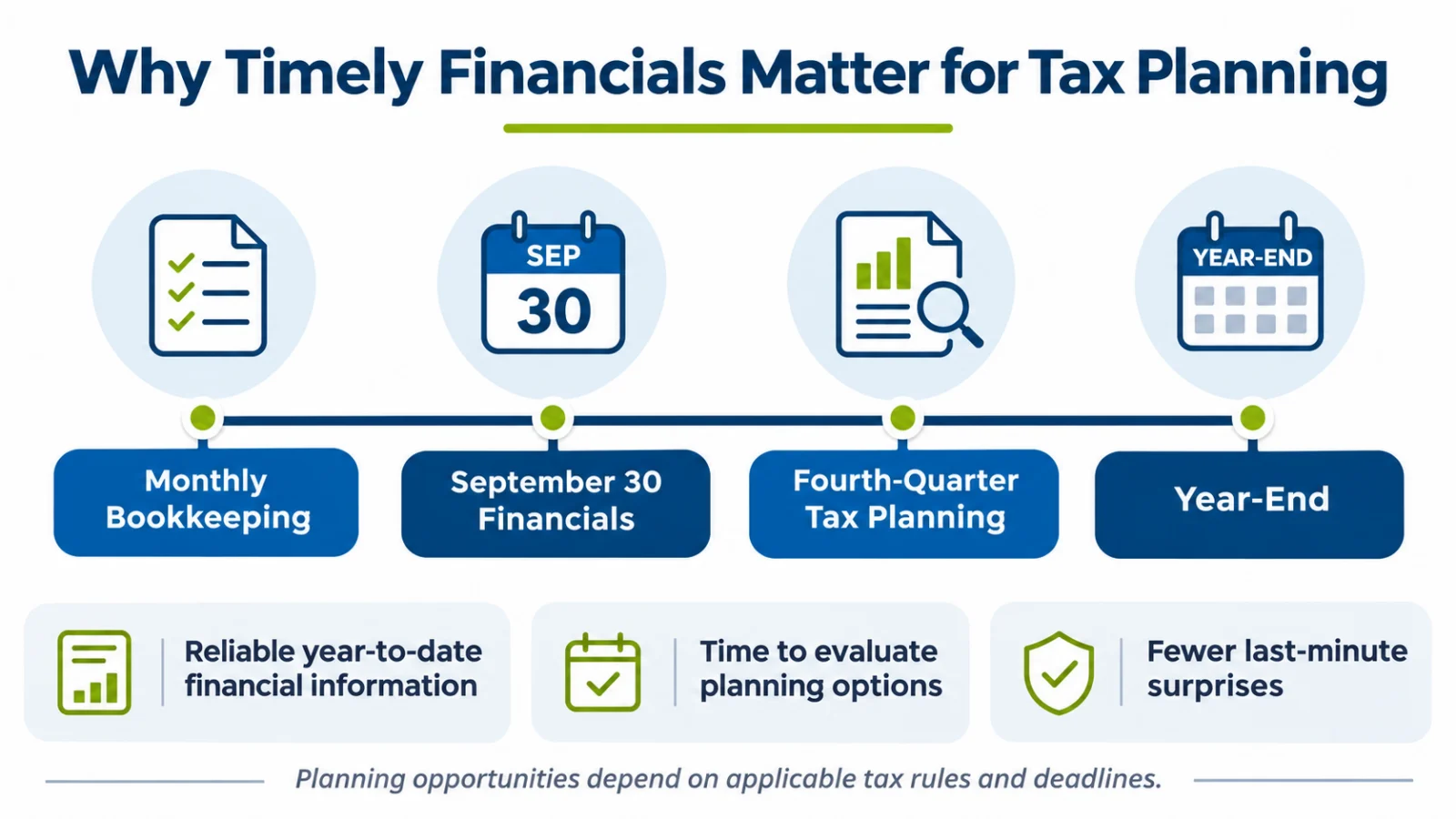
For example, the IRS discusses plan-specific contribution timing in Publication 560, Retirement Plans for Small Business. Confirm the rules and deadlines that apply to your business before acting.
Why Waiting Until Tax Season Creates Problems
Some business owners treat bookkeeping as something that primarily exists to support tax returns. They enter transactions throughout the year, or sometimes catch up on several months at once, and then send the information to their accountant during tax season. That approach may produce records sufficient to prepare a return. But it can leave the owner operating without timely financial visibility for much of the year.
It also shifts attention toward historical reporting rather than forward-looking decisions. Consider what happens when a business doesn’t finalize its financials until two months after year-end. At that point, management can review the prior year’s performance. But the opportunity to change many of the business decisions that affected that year has already passed. The company can learn from the results.
It just cannot go back and make every decision differently. A monthly close helps avoid that problem by creating regular opportunities to review and respond.
Monthly vs. Quarterly Financial Reporting: Which Is Better?
Businesses may review financial information monthly or quarterly. Both can be useful. The appropriate frequency depends on the company’s size, complexity, reporting obligations, and decision-making needs. For a smaller business with relatively simple operations, quarterly financial reviews may provide some meaningful oversight. However, monthly closing generally offers more timely visibility. A growing business with employees, financing obligations, inventory, multiple revenue streams, or significant cash flow activity may benefit from monthly financial reporting.
The important distinction is between a deliberate reporting schedule and simply allowing the books to fall behind. If you choose quarterly reporting, the records still need to be accurate and current enough to support important decisions. And if your lender or another party requires monthly information, that obligation should guide your reporting process.
What Should a Good Monthly Close Include?
The exact closing process will vary, but a practical month-end review often covers several important areas.
1. Bank and Credit Card Reconciliations
Reconcile accounts to help identify missing transactions, duplicates, and discrepancies.
2. Revenue and Expense Review
Confirm that revenue and expenses have been recorded appropriately and review unusual changes.
3. Accounts Receivable and Accounts Payable
Understand who owes the business money, which invoices are overdue, and what obligations the company needs to pay.
4. Payroll and Loan Activity
Review payroll records, loan balances, and related accounting entries.
5. Financial Statement Preparation
Prepare the profit and loss statement, balance sheet, and relevant cash flow information.
6. Management Review
Compare actual results against goals, budgets, and prior periods. The last step is particularly important. A monthly close should not end with reports being generated and filed away. Someone needs to review them. The purpose is to understand what happened and decide what needs attention.
When Does a Business Need Professional Help With the Monthly Close?
Not every business needs a full-time accounting department. But as companies grow, the monthly close can become more demanding. More transactions require review. Accounts become more complex. Payroll increases. Financing arrangements add reporting requirements. Management needs more detailed financial information. At some point, the owner or administrative employee who has been handling bookkeeping may no longer have the time or expertise needed to close the books consistently.
That’s often when professional monthly bookkeeping, controller services, or outsourced accounting services become valuable. A bookkeeper may handle transaction recording and reconciliations. A Controller may oversee the closing process, financial accuracy, and reporting. A Fractional CFO may use those reports to support forecasting, strategy, and financial decisions. The appropriate level of support depends on the business. What matters is having someone responsible for producing reliable financial information on a consistent schedule.
Financial Reporting for Business Owners: A Tool for Running the Business
One of the biggest misunderstandings about accounting is that financial reports are primarily for accountants. They’re not. They’re for business owners. Your profit and loss statement helps explain whether operations are producing the results you expected. Your balance sheet helps explain the company’s financial position. Cash flow information helps you understand liquidity. Together, those reports provide context for decisions about staffing, spending, financing, and growth.
But their usefulness depends on timing. A financial report that arrives months late may still be accurate. It may simply arrive too late to support the decision you needed to make. That’s why the monthly close matters. It creates a regular opportunity to ask: Did we meet our goals? If not, why? What changed? What needs attention?
What should we do differently next month? Those are management questions, not just accounting questions.
Monthly Bookkeeping and Financial Reporting for Utah Businesses
Business owners in Kaysville, Layton, Roy, Farmington, Riverdale, Ogden, and surrounding Utah communities often face increasing accounting complexity as their companies grow. What began as a manageable bookkeeping process can become more demanding when the business adds employees, financing arrangements, or multiple revenue streams. At FJ & Associates, we help business owners maintain organized financial records and understand the information they need for better decision-making.
Our professional monthly bookkeeping, accounting, proactive business tax planning, and advisory services can support businesses that need more consistent financial reporting throughout the year. Whether you’re comparing bookkeeping services in Kaysville, Utah, looking for a CPA serving Layton, or need an accountant serving Roy, a clear closing schedule is a practical place to start. Growing businesses across Davis County and Farmington may also need controller services in Utah or business tax planning support near Ogden as reporting becomes more complex.
Key Takeaways
- A monthly close provides financial visibility. It helps owners understand profitability, cash flow, and financial position.
- You can’t measure progress without reliable results. Financial goals are more useful when actual performance is reviewed consistently.
- Delayed reporting affects decisions. Hiring, spending, financing, and growth planning can become harder without current information.
- Loan covenant reporting may depend on timely financials. Businesses with lender requirements need to understand their reporting obligations.
- Tax planning requires current records. Reliable year-to-date financials can support projections and decisions before year-end.
- Monthly reporting is usually more timely than quarterly reporting. The right frequency depends on the business and its obligations.
- Someone needs to own the process. Whether internal or outsourced, responsibility for closing and reviewing the books should be clear.
Conclusion
The monthly financial close is not simply an accounting deadline. It’s an important part of understanding how your business is performing. Without reliable financial statements, business owners can struggle to evaluate goals, understand cash flow, satisfy lender reporting requirements, and make timely tax planning decisions. The longer reporting falls behind, the more difficult those decisions can become.
And when financial information isn’t available until months after year-end, some opportunities to respond have already passed. The goal is not to produce reports for the sake of producing reports. It’s to have reliable information when you need it. If your business is consistently falling behind on monthly financial reporting, FJ & Associates can help you establish a more dependable bookkeeping and closing process so you can make decisions with greater confidence. Discuss your monthly financial reporting with our team.
Frequently Asked Questions
-
What is a monthly financial close?
A monthly financial close is the process of reviewing, reconciling, and finalizing accounting records for a completed month so the business can prepare reliable financial statements.
-
Why is the monthly close important for small businesses?
It helps business owners understand profitability, cash flow, expenses, and progress toward financial goals while there’s still time to make adjustments.
-
What happens if I don’t close my books every month?
Financial reports may become outdated or incomplete, making it harder to evaluate business performance, manage cash flow, prepare tax projections, or satisfy certain lender reporting requirements.
-
How long should a monthly close take?
The time required depends on transaction volume, accounting complexity, available records, and the company’s processes. Businesses should establish a consistent schedule appropriate to their operations.
-
Is quarterly financial reporting enough?
Quarterly reporting may be appropriate for some businesses, but monthly reporting generally provides more timely information. Lender requirements and operational complexity may also affect the necessary frequency.
-
Why does my CPA need September 30 financial statements?
Reliable financials through September 30 provide a useful year-to-date starting point for fourth-quarter tax projections and planning discussions.
-
Can I still do tax planning after the year ends?
Some tax-related decisions and contributions may remain available after year-end, depending on applicable rules and deadlines. However, many business decisions affecting the tax year must be made before the year closes.
-
What financial statements should I review each month?
The profit and loss statement and balance sheet are common starting points. Cash flow information, receivable and payable aging, and budget comparisons may also be useful.
-
Who should be responsible for the monthly close?
Depending on the business, the process may be handled by a bookkeeper, accountant, Controller, or outsourced accounting team. Management should still review the results.
-
Can a CPA help if my bookkeeping is several months behind?
Yes. A CPA or qualified accounting team can help assess the records, identify reconciliation issues, and establish a process for producing more timely financial reports.
About the Author
Missy Dennis, CPA
Partner | FJ & Associates, PLLC | Kaysville, Utah
Missy holds a Master of Accounting degree from the University of Utah and is a licensed Certified Public Accountant. With more than 20 years of public accounting experience, Missy provides practical financial and tax guidance to individuals, business owners, and organizations. Her areas of expertise include:
- Tax preparation and advisory
- Bookkeeping strategy alignment
- Estate and trust taxation
- Audit and consulting services
- Low-income housing tax credits
- Nonprofit accounting
- Small- and mid-sized business advisory
Missy is committed to helping clients understand their financial position and make informed decisions with greater confidence.
